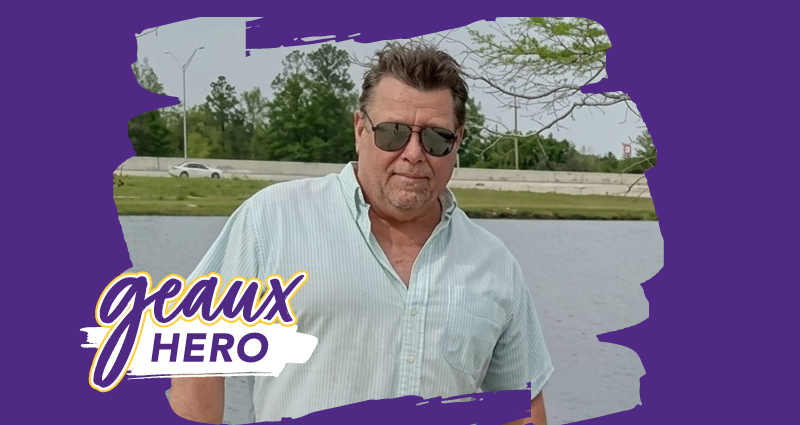
Roger Cutrer is used to staying busy.
The Baton Rouge native has owned a land title research business for 25 years, keeps an active schedule and spends plenty of time in the gym. Slowing down has never come naturally.
For several years, though, Roger noticed his energy was not what it used to be. Then earlier this year, he began experiencing episodes that were harder to dismiss. His chest would tighten, along with his arms and back, for about 10 minutes at a time.
At first, Roger thought stress might be the cause. An EKG and calcium score had not pointed to an obvious heart problem, and his blood pressure was normal. Still, the symptoms continued.
“I kept having these spells about every other day,” Roger says.
Eventually, further testing at FMOL Health | Our Lady of the Lake Heart & Vascular Institute revealed a blockage in his heart. The plan was to place a stent on Friday morning and send him home shortly afterward.
What doctors found during the procedure changed everything.
An Unexpected Turn and a Quick Decision
During the procedure, Roger’s care team discovered two additional blockages. All three were severe, with arteries nearly completely blocked.
The stent procedure stopped, and Roger woke up to learn that he needed triple bypass surgery.
Cardiologist Federico De Puy, MD, helped identify the extent of Roger’s heart disease after earlier testing had not revealed the full problem.
“He really helped find this issue,” Roger says. “He prayed with me.”
Roger and his wife, Heather, suddenly faced a choice. They could wait through the weekend and schedule surgery for Monday, or move forward immediately.
“I look at Heather and I’m like, ‘Are we just going to sit around all weekend and stress about it? Let’s just do it,’,” Roger says. “And she’s like, ‘Let’s do it.’”
Within minutes, cardiovascular surgeon Terry Stelly, MD, and his team began preparing him for surgery. Dr. Stelly performed the triple bypass that day, June 19.
“I didn’t have time to get all anxious and nervous,” Roger says. “I woke up Saturday in the hospital.”
A Close Call He Never Expected
The diagnosis surprised Roger because he had done many of the things people associate with staying healthy. He exercised regularly, watched his diet and considered himself to be in good physical condition.
Doctors told him he had been dangerously close to a heart attack.
His longtime cardiologist, Paul Dampf, MD, had already urged Roger to cancel a planned trip to Chicago when they thought a stent was all that was needed. Roger had been planning to spend the weekend watching the Cubs at Wrigley Field.
Instead, he stayed in Baton Rouge and received the care he needed.
“They got me before I had a heart attack, thank God,” Roger says. “It could have been any minute. I could have died or had a bad heart attack.”
The experience reinforced something Roger now wants others to understand. Heart disease can affect people who exercise, eat well and feel like they are doing everything right.
“You’ve got to listen to your body if you think something is wrong,” he says. “No matter if you’re a gym rat, a marathoner, I don’t care. Go get checked.”
Learning to Slow Down and Heal
The day after surgery, Roger got out of bed and tried to walk. He didn’t make it far.
“I could only take about five steps and I was done,” he says.
Those first steps gradually became walks through the hospital hallways. In the weeks that followed, Roger returned to driving, walking regularly and eventually going back to the gym within the limitations set by his care team.
For someone accustomed to staying busy, the hardest part has often been accepting what his body cannot yet do. Dr. Stelly understood that challenge.
“He told me, ‘Guys like you are my toughest patients because you’ve got a lot of stuff going on and you want to go, and your body is telling you no,’” Roger says.
Roger also credits cardiologist Andrew Smith, MD, a longtime friend who happened to be on call during his hospital stay. Dr. Smith checked on Roger throughout the weekend, answered questions and helped him navigate those first days of recovery.
Roger says that same level of care extended throughout the Our Lady of the Lake Heart & Vascular Institute team.
”The doctors, the nurses were five-stars,” he says. “They were awesome. Just nice, compassionate.”
His recovery continues, but each week brings progress and a deeper appreciation for how close he came to a very different outcome.
“You hug a little harder and listen a little longer,” Roger says.
Five Steps Become a Walk on the Field
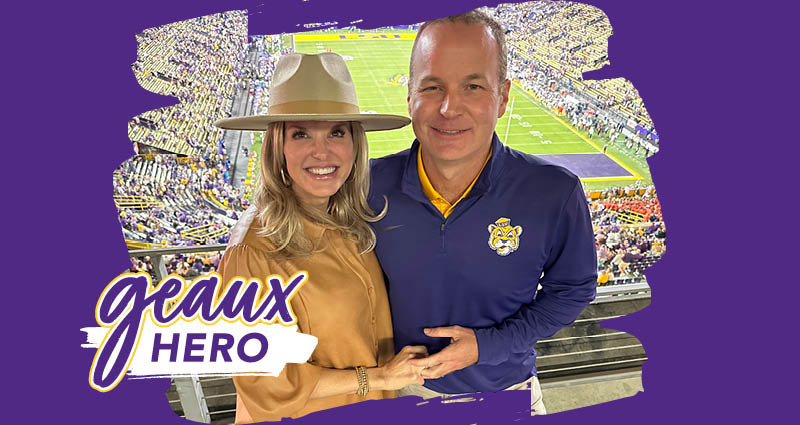
Only weeks after struggling to take five steps in the hospital, Roger will walk onto the field at Tiger Stadium when LSU opens the football season vs. Clemson as an Our Lady of the Lake Geaux Hero.
The recognition means a great deal to him, although Roger is quick to focus on the message he hopes his story can share.
“I don’t want to be treated like a hero,” he says. “Let me be a message to people. Let me help.”
Roger describes his surgery as a second chance. The experience has changed how he views time with his wife, family and friends and shown him how much their support means.
“I feel like I’ve got a second chance,” he says. “I was pretty close to something really, really bad happening to me, and I consider myself blessed.”
Now, he hopes his experience encourages others, especially men who may be tempted to ignore fatigue, discomfort or other signs that something feels wrong.
“If people can hear my story and I can help somebody catch something before it happens, it means a lot,” Roger says. “If I can save somebody’s life, that’s wonderful.”