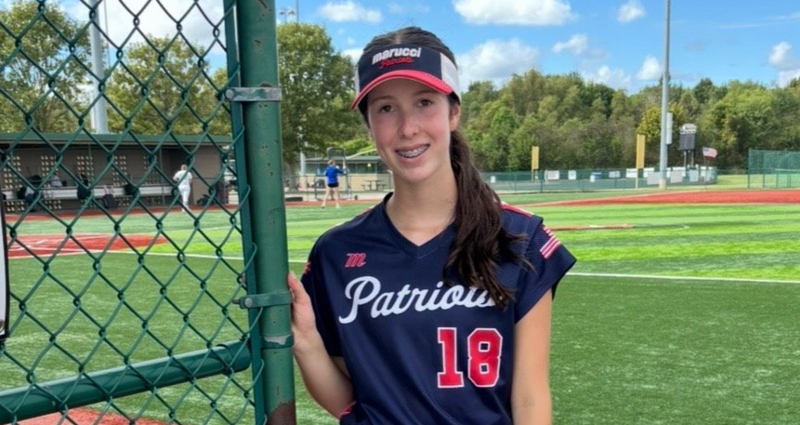
For nearly seven years, Shannon Landaiche watched her daughter Stevi do what she always did: push through, show up and compete.
Softball games, X-rays, bracing, physical therapy, more X-rays. Quietly and without complaint, Stevi managed her scoliosis, which is a progressive change in curvature of the spine, through every practice, every game and every six-month checkup. Scoliosis is a 3-dimensional deformity impacting multiple angles and alters the mechanics in function as the condition worsens.
As she grew taller, the curve grew with her, bringing with it a familiar ache: pain that flared when she sat too long in class or rode in a car. Her right shoulder would sometimes go numb when writing. Her rib would shift out of place and sometimes, her hand even turned purplish in color. Stevi would change positions or lean on her backpack to alleviate the symptoms.
Still, she showed up. Still, she competed. Then the day came when Brad Culotta, MD, made the recommendation Shannon had been quietly dreading: spinal fusion.
“My world stopped,” Shannon says. “It’s one of those conversations that I knew was inevitable, but I was never ready to truly hear it, talk about it and face it head-on.”
That surgery, and everything surrounding it, would become one of the most defining chapters of their family’s life. It’s a story of faith, teamwork and the kind of care that changes a person, made possible by Stevi’s very own orthopedic physician. The family didn’t have to even leave Stevi’s hometown.
A Quiet Battle Behind a Strong Swing
Long before surgery entered the picture, Stevi was already a fighter.
She poured herself into softball, playing travel ball for six years, starting at the age 8. She would play full weekends, up to eight games in brutal heat and sometimes with no breaks between games.
Shannon worked on Stevi between games with repeated taping, icing, pain meds and stretching just to manage the pain. Stevi never gave up or said she wanted to stop playing softball. She kept fighting.
Stevi was going into her freshman year, disadvantaged due to her worsening scoliosis. High school competition is steep, and she had to make a decision on when the time would be right for surgery. She knew that she would lose at least six months of playing and it would take months to regain strength.
On the field, she looked like any other determined young athlete.
Her body started to tell a different story. When she threw, her shoulder ached. The rotation she relied on now working against a spine that kept shifting. In class, her whole arm would go numb. On long car rides, the discomfort was relentless. She learned to adjust her position, change her mechanics, compensate.
She was working harder than anyone watching her could see, managing a body that was quietly changing beneath her.
“Many people never knew exactly what Stevi was battling internally because she wouldn’t be the type of person to show her pain,” Shannon says. “She worked hard to become the best athlete possible.”
Stevi confirms it. The discomfort was always there — she just kept going. “As I got older, my curvature was worse and that made my pain increase,” she says. “I realized I’d like to look into surgery. I didn’t want to get worse and have the pain increase later on.”
Stevi’s diagnosis was adolescent idiopathic scoliosis. Dr. Culotta, pediatric orthopedic surgeon at FMOL Health | Our Lady of the Lake Children’s Hospital, cared for Stevi throughout her journey. He specializes in children from birth to age 18, with a special focus on spine and spinal deformities.
“Scoliosis is a twist of the spine that happens commonly in otherwise healthy, growing kids,” Dr. Culotta explains. “That’s what Stevi developed.”
He treats about 70 to 80 scoliosis patients each year. Most, he notes, never need an operation.
“Mostly we can avoid surgery,” he says. “But when we need it, it’s effective at improving it for the long term.”
Nearly Seven Years of Watching, Waiting and Hoping
For almost seven years, Stevi and her mom came back every six months for follow up visits to determine if there was any change to the curvature. Stevi had repeated X-rays with and without her brace and every year without fail, Stevi had to get fitted for a new nighttime brace because she would grow out of the brace.
The brace was uncomfortable and many times, Stevi couldn’t make it through the night wearing it. Dr. Culotta continued to monitor her scoliosis until surgery became necessary when she was 14.
The family tried every conservative option to slow the curve: Schroth physical therapy, night bracing, stretching exercises, taping, postural support and education. But as Stevi grew taller, the curve grew with her.
The family once explored an alternative procedure called ApiFix. But in the end, they set that option aside and chose to wait and watch.
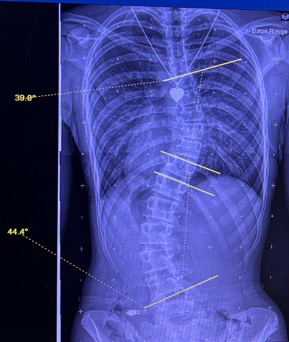 When the scoliosis continued to worsen, Dr. Culotta raised surgery again. This time, a spinal fusion. The plan had grown, too. What began as a procedure spanning spinal levels T10 to L4 expanded to a 13-level fusion, from T4 to L4.
Shannon knew this world well. As a physical therapist and a leader within Our Lady of the Lake for more than 25 years, she had spent her career recommending its providers and clinicians with confidence. Hearing it as a mom was different.
“When your child ends up needing surgery, it becomes very real, and I never considered going anywhere else,” she says. “I had complete confidence in Dr. Culotta’s expertise, and I knew we could receive this level of care right here without ever leaving home.”
In 2019, Stevi had spinal measurements at much lower degrees. Her thoracic spine measured 9.5 degrees, and her lumbar spine measured 20.2 degrees. Years later, Stevi’s scoliosis worsened with thoracic spine measuring 39.0 degrees and her lumbar spine at 44.4 degrees. Stevi’s spine had taken the form of an “S” curve literally.
Dr. Culotta saw that layered experience firsthand.
“She’s somebody that’s a knowledgeable mom because of her therapy background,” he says. “But scoliosis, when it’s your own daughter, is a different hat. A different experience, a different stress level. You see it from the other side.”
The Turning Point
For Shannon, peace arrived when she let go.
“Once I turned my daughter’s needs to God, this was my turning point,” she says.
From there, she focused on preparation: learning what to expect, getting Stevi ready and connecting with other families to hear their stories. A seven-plus-hour surgery worried her, but her trust ran deeper than her fear.
Shannon sought out to talk to families with success stories of athletes who had to undergo spinal surgery. She spoke to several families in state who had successful stories and Shannon was convinced Stevi would be another successful one.
“My trust in Dr. Culotta and our team overshadowed my fear,” Shannon says. “I became at peace to experience our Children’s Hospital from the patient side, knowing that this spinal correction was going to be a life-changing event for Stevi. I was tired of seeing her struggle, and I wanted Stevi to find relief. I knew that her recovery would be challenging, but we were talking about her quality of life.”
A Surgical Team and a Sacred Moment
On the morning of surgery, familiar faces met the family at every turn. At check-in and in pre-op, Shannon recognized team members she had worked alongside for years, including a CNA and a nurse who had just marked their own 25-year work anniversaries, the same milestone she had reached.
“These relationships sparked conversation and started to settle my nerves,” she says.
One by one, in an organized, unhurried flow, the specialists arrived. Not all at once, not in a rush but steady and purposeful, each one stepping in to explain their role, walk the family through what to expect and invite any questions. The anesthesiologist. The CRNA. The neuromonitoring lead. Child life. Each arrival felt less like a clinical handoff and more like a team assembling around a shared purpose.
“Everything was orchestrated,” Shannon recalls. “They didn’t overwhelm us. It was a constant flow, and they were all at ease, relaxed and ready to answer any questions.”
No one rushed. No one made the family feel like a checkbox on a list. Stevi and her family met nearly every person who would be in that operating room, and they knew exactly what each one was there to do. When Shannon glanced through the pre-op room window just before Stevi was taken back, she saw them all assembled and ready.
“It was like an army,” she says. “An army on our side.”
Then Dr. Culotta arrived to review the plan. And just before the team took Stevi back, he sensed the family needed something more than a medical briefing.
They all joined hands, and he led them in prayer.
“This final prayer sealed the deal for me and gave us peace as we endured the next seven to eight hours,” Shannon says. Looking beyond her pre-op room, she saw the full team assembled and ready. “I looked outside of our pre-op room, and I saw a surgical army standing outside of our room ready to begin.”
For Dr. Culotta, that moment reflects something central to how he practices.
“Most of us rely on our faith to get us through difficult times, and I often see people when they’re at their most challenging times,” he says. “When you can find that common ground, that we all need support from above to do what we do, it helps the parent, the patient and everyone involved feel like we’re all there for a common purpose.”
World-Class Care, Close to Home
Surgery began at 8:03 a.m.
Every hour, an OR nurse carried updates to a waiting room filled with family. By early afternoon, the final call came: the team was closing, with no complications. The result was a 13-level fusion with 22 screws and two rods, precise and complex work made possible by advanced technology. The surgery had taken exactly six hours, just as Dr. Culotta had predicted.
For a surgery like Stevi’s, precision is measured in millimeters.
“We use spinal navigation for this surgery, image guidance to place implants in the narrow, twisted corridor of the deformed spine,” Dr. Culotta explains. Alongside it, the team relies on:
- Neuromonitoring that provides real-time feedback about the health of the spinal nerves and spinal cord, keeping the procedure safe.
- Cell saver technology that recycles blood to reduce the need for transfusion.
- Advanced navigation techniques that support spine deformity care from the smallest patients to fully grown teens.
“Any pediatric hospital across the country, you’d put us up against for our capabilities and technologies to provide that care,” Dr. Culotta says.
What moves him most is that families like Stevi’s never had to travel far to receive it.
“I am from Baton Rouge,” Dr. Culotta says. “Having that close to home is hugely reassuring. They don’t have to travel outside of their comfort zone to get care.”
For Stevi, that meant something simple and profound. “She never really had to leave her circle of normal life to get all of that,” Dr. Culotta says.
Rising, One Step at a Time
 Recovery from a fusion this significant is a long road.
“Once I got out of surgery, since everything was so different, I thought it would be a long transition and I wouldn’t get back to where I was before,” she says. “But I was wrong about that.”
On the first day after surgery, therapists arrived to help her stand and move into her new posture, patient and encouraging as she worked through medication adjustments and blood pressure changes.
The early days were humbling. Sitting up was hard. Walking was harder. Washing her face at the sink meant shooting pain if she bent too far. She learned to do everything differently, reaching from above and below where her spine was now fused. She leaned into the work, stayed positive and kept her eyes on the field.
“A lot of it just took practice,” Stevi says. “I had to figure out my new body and what it was going to take to get things done differently.”
Outpatient physical therapy at our Children’s Hospital played a central role in Stevi’s recovery, building strength and flexibility while relearning mechanics.
Around the eight-month mark, the pain in her back finally stopped completely. Her sensation is still returning. Nerve regeneration can take a few years, but the trajectory has been steady and sure.
The surgery changed Stevi in ways that go beyond a straighter spine. She grew an inch, and the rib that used to pop out on her right side no longer does. The shortness of breath she’d notice during games, likely from a lung that had been slowly compressed by the curve, has disappeared.
“It went from an S curve to almost completely straight,” she says. Things she once dreaded, like long car rides, no longer hold her back.
And for anyone who might be facing the same road she once walked, Stevi’s message is straightforward: don’t wait, stay positive and trust the team around you.
“I’m definitely glad I chose to have surgery when I was younger,” she says. “I recovered a lot faster because I was young and resilient.”
Dr. Culotta credits Stevi’s spirit for much of her progress.
“The fact that she was motivated and positive and kept a good attitude throughout helps through the recovery process,” he says. Today, she is healed, recovered and back to the sport she loves.
She’s also become something more. Many young patients form bonds with others facing the same journey, and Stevi has embraced that role. “She’s been willing to be an advocate for other kids,” Dr. Culotta says. “That’s been cool.”
A Blessing to the Whole Community
Stevi’s story is her own, but it reflects a larger truth about what Our Lady of the Lake Children’s Hospital means to the families it serves. It’s a place where clinical excellence meets genuine compassion, where surgical teams stand ready, where prayer and precision share the same room, and where world-class care lives right in your own backyard.
Shannon says it best.
“The experience that Stevi and our family experienced at Our Lady of the Lake Children’s Hospital was simply incredible,” she says. “The experience was one of a kind, and we are extremely grateful. This was a life-changing surgery, and we will forever be indebted to our amazing Children’s Hospital.”