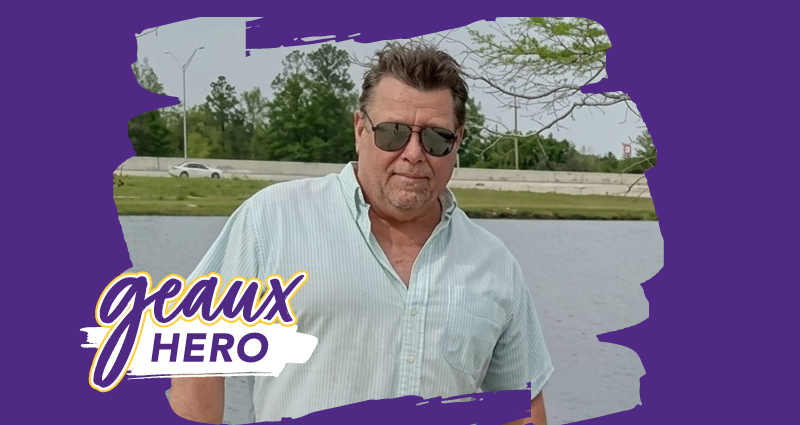
Curtis Jeffery was used to being the one others depended on.
A home improvement contractor from Bluff Creek, Curtis made a living fixing things. So, when Curtis began having stomach problems, he did what he could to keep going.
He and his primary care physician thought he was dealing with an ulcer. He took the usual stomach medications and underwent several tests, but nothing seemed to help. The pain continued until one day it became so severe that Curtis had to leave work.
He came home doubled over with cramps. His wife, Mary, took one look at him and insisted they go to the hospital. It was Oct. 3, 2025, the day after Curtis’s 60th birthday.
At the FMOL Health | Our Lady of the Lake Livingston Emergency Room, a nurse and attending physician kept searching for an explanation for his pain. Something about what they were seeing made them want to look deeper, and they ordered a CT scan.
“They just went over and above to find out what was wrong with me,” Curtis recalls.
The scan gave Curtis an answer. It was one he never expected.
Doctors found a tumor on his pancreas.
In a matter of hours, Curtis went from thinking he had an ulcer to riding in an ambulance to FMOL Health | Our Lady of the Lake Regional Medical Center. The husband and father who had spent his life taking care of things suddenly found himself facing pancreatic cancer and depending on others to take care of him.
Facing a Diagnosis He Feared
Curtis knew what cancer could take from a family. He had lost a brother and other family members to the disease. When he heard the words “pancreatic cancer,” his mind immediately went to the people he loved.
He thought about Mary. He thought about his five children — the youngest just 7 years old. Most of all, he thought about the possibility of leaving them before he was ready.
“The first thing I did in the hospital, I made my wife bring me the laptop, make sure my life insurance policy was okay and all the affairs,” Curtis recalls. “No matter what they were telling me, pancreatic cancer is a goner. That’s what I thought.”
The fear came in waves. So did the questions. Curtis had always been fiercely independent, and suddenly he had to place his life in the hands of people he had only just met.
His care team moved quickly. Within days, Curtis began an aggressive chemotherapy regimen. He underwent six months of treatment before an extensive Appleby procedure that removed about 60 percent of his pancreas, along with his spleen and gallbladder.
The treatment was grueling, and recovery was difficult. Curtis also saw how deeply his diagnosis affected Mary and their children. His care team recognized that his family needed support, too. They stayed in close contact with Curtis and Mary, checking in by phone and making themselves available when questions or concerns came up. During chemotherapy, they also made sure his children felt welcome and included at a time when so much of their family’s life had suddenly changed.
That care meant even more to Curtis because he knew Mary was carrying the weight of the experience alongside him. She was caring for their children while supporting him through chemotherapy, major surgery and recovery.
“When you go through cancer, your whole family goes through it,” Curtis says. “They treated my kids wonderfully. It was just unbelievable.”
Finding Hope in Stage 1
As Curtis tried to comprehend his diagnosis, his doctors kept telling him something he struggled to understand: He was fortunate.
The cancer had been found at stage 1.
The tumor had developed near a cluster of nerves, creating the intense stomach pain that sent Curtis to the emergency department. That pain became an unexpected warning that something serious was happening inside his body.
At the time, Curtis could hardly see it that way. He had pancreatic cancer. His pancreas was causing other health problems, including diabetes. He was scared, sick and facing an uncertain road.
“I have pancreatic cancer and I’m a full-blown diabetic. I don’t see how lucky I am,” Curtis remembers thinking. “They found me at stage one. I just wasn’t catching it at the time. It hadn’t set in how serious this diagnosis was.”
As treatment continued, he began to understand.
Curtis credits his care team, including surgeon Mo Al Efishat, MD, oncologist Ajay Tambe, MD, nurses, nutrition specialists and others, with carrying him and his family through some of their hardest days.
For a man who had never liked depending on anyone, learning to accept that care became part of his journey.
A Second Chance With a Purpose
Somewhere along the way, Curtis made a decision.
He could not control every scan, every side effect or every difficult day. He could control what he brought into the room.
At the infusion center, Curtis became the patient cracking jokes. He pushed his IV pole around, introduced himself to others, shook hands and prayed with people. Even when he felt physically depleted, he looked for opportunities to lift someone else.
“I feel sometimes like I’m obligated to help others that went through this,” Curtis says. “I’m going to do my best to do that in my volunteer work.”
That sense of purpose has followed him out of treatment. Curtis has connected with other cancer survivors and plans to share his story with people facing pancreatic cancer.
He remembers how frightened he was when he was first diagnosed. He remembers looking at his young children and wondering how much time he had left. Now he wants someone else in that position to see what he could not yet see during those first frightening days: There can still be hope ahead.
A Moment to Celebrate
Mary and the kids recently had another surprise waiting for Curtis.
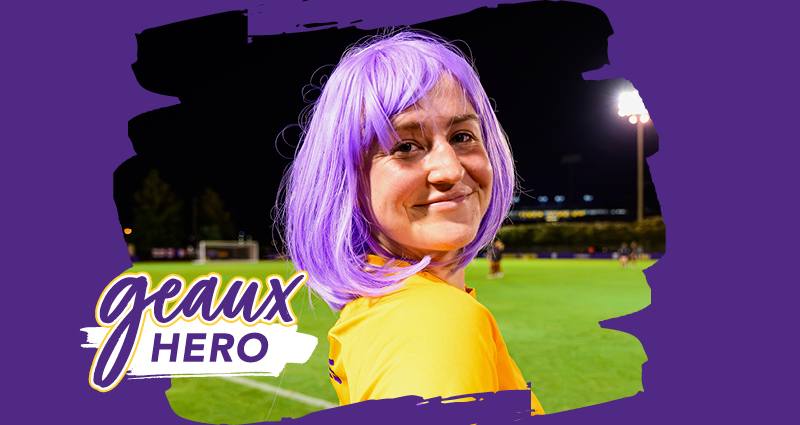
He knew they were keeping something from him. There was too much whispering and snickering for them to hide it very well. Then they finally told him: Curtis had been chosen as an FMOL Health | Our Lady of the Lake Geaux Hero.
For a longtime LSU fan, the chance to walk onto the field at Tiger Stadium was already a special birthday gift.
Then there was the date.
The LSU game against McNeese State will be played Oct. 3 — exactly one year since Curtis walked into an emergency department in pain and got the diagnosis that changed his life.
The game also comes one day after his 61st birthday.
This time, Curtis approaches Oct. 3 with different news. His latest testing shows no evidence of cancer.
“Just in time for me to celebrate on the 3rd,” he says.
The moment will belong to Mary and their children, too. They were there through the fear, chemotherapy, surgeries and recovery. Now they will be there to watch him step onto the field.
For Curtis, the journey has also clarified what he wants to do with the life ahead of him.
“I can’t just go fishing and hunting and forget about this,” he says. “I have to do something about this. I have to encourage others.”
And when thousands of people see Curtis standing on the field at Tiger Stadium, that is the message he hopes they carry with them.
“Never give up. Never lose hope.”