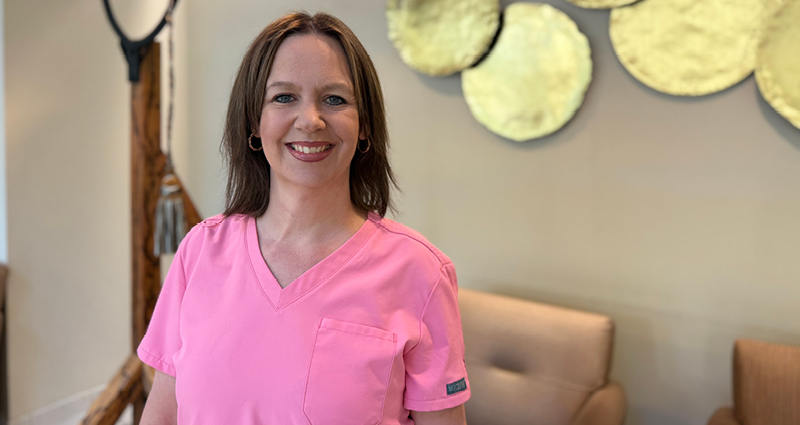
For years, MJ Irby watched patients walk through the doors of the Cancer Center at FMOL Health | St. Dominic carrying fear, uncertainty and questions about what came next.
She learned their names and their families. She celebrated good news with them and saw them through difficult days. She knew how much a warm blanket, a familiar face or a few reassuring words could mean.
Since joining St. Dominic in 2007, MJ has spent her career in oncology, helping patients navigate the details that come with cancer treatment. Her work touches everything from insurance approvals and treatment authorizations to the everyday needs of patients and their families. Along the way, those patients have become much more than names on a schedule.
“You get to see them in a walk of life where they’re at their most vulnerable,” MJ says. “You have a connection with the patient. You want to see them succeed.”
For more than 16 years, MJ understood cancer through the experiences of the people she served. She could listen, encourage them and help make a difficult day a little easier.
Then one day in 2023, MJ walked through those same doors carrying a cancer diagnosis of her own, and she learned what that journey felt like from the other side.
When Cancer Became Her Diagnosis
MJ was 45 when she went for her annual mammogram in April 2023. She had recently undergone another surgery, and there was an opportunity to delay her screening until later in the year.
MJ refused.
“You don’t miss a mammogram when you work here,” she says. “When you work in oncology, you learn you do not pass it off.”
The mammogram led to additional imaging and eventually a biopsy. The area was small, and MJ knew most biopsies come back benign. Still, she had a feeling something was wrong.
The results initially appeared to show ductal carcinoma in situ, or DCIS, an early form of breast cancer. Her team began planning a lumpectomy.
Then MJ underwent genetic testing, and the plan changed.
Through years of working in oncology, MJ knew plenty about cancer. None of that knowledge could fully prepare her to hear the diagnosis herself.
“When you hear the word cancer and your name’s attached to it, it’s different,” she says. “It hits you different.”
Her thoughts quickly turned to Donovan, her husband, their four children and the life they had built together. Their youngest child was only 4 at the time.
The uncertainty was overwhelming. MJ describes it as a valley that affected her mentally, physically, emotionally and spiritually.
A Treatment Plan That Kept Changing
Genetic testing revealed that MJ carries a CHEK2 gene variant associated with increased breast cancer risk. Her planned lumpectomy was canceled, and she underwent a bilateral mastectomy and reconstruction in June 2023.
Then the final pathology brought another unexpected turn.
Doctors discovered a tiny amount of cancer in one of MJ’s lymph nodes, changing her diagnosis from DCIS to invasive breast cancer. What had once appeared likely to require a relatively straightforward surgery grew into a much more extensive treatment plan.
MJ ultimately underwent six chemotherapy treatments and 11 immunotherapy treatments. She completed chemotherapy in October 2023, immunotherapy in February 2024 and her surgeries during the first part of 2024.
Throughout treatment, she continued working except on chemotherapy days. Routine helped her manage the anxiety, while her family, church and St. Dominic coworkers surrounded her with support.
Her husband attended every chemotherapy treatment. Her mother came with her, and coworkers visited with warm blankets, snacks or simply time to sit beside her.
“I couldn’t ask for better support,” MJ says. “God, my church, my church family, my family, my work family. They just came in different ways, but in the most perfect ways. Things I didn’t know I needed, they knew.”
Seeing Cancer Care Through a Survivor’s Eyes
MJ had spent 16 years walking alongside cancer patients before her diagnosis. Becoming one herself gave her a perspective she now carries into every interaction.
“For so many years, I’ve been a part of a patient’s journey,” she says. “I could have sympathy, I could have empathy, I could do anything for a patient. But I didn’t know what it was like to walk in their shoes.”
Today, patients, coworkers and friends regularly seek her out after a diagnosis. Sometimes they have questions about treatment. Other times, they simply need someone who understands the fear and uncertainty that can accompany cancer.
MJ has seen patients’ expressions change when they learn that the person sitting across from them has also faced breast cancer, chemotherapy and the uncertainty of what comes next.
Her experience has also deepened her appreciation for every person involved in cancer care. From the radiologist who notices a subtle change on an image to the physicians developing a treatment plan and the team members helping patients through each appointment, MJ sees how every piece matters.
“There’s so many pieces to the puzzle, and everybody is so important,” she says.
Cancer remains part of her life even after treatment. There are still thoughts about recurrence and what the future holds, but MJ’s faith has helped her find peace in the uncertainty. She says God met her in the deepest valleys of her journey and helped lift her through the toughest times.
“Through this journey, I realized what the true meaning of faith was and the peace that comes with it,” MJ says.
MJ chooses to use those experiences to connect with others.
“I am still here to tell a story,” she says. “I am still here to show people there’s light at the end of the tunnel.”
A Message to Women: Advocate for Your Health
MJ’s experience has given her a clear message for other women: stay on top of your health and speak up for yourself.
Her own diagnosis began with a mammogram she refused to postpone. Genetic testing also revealed information that now helps her family understand its own risk. One of her daughters has since tested positive for the same CHEK2 variant and can work with her healthcare providers on appropriate screening.
“Always get checked. If ever in doubt, get checked. Never miss one of your appointments,” MJ says. “As a woman, you have to be an advocate for yourself.”
She encourages women to keep recommended screenings on their calendars, follow up when something does not feel right and ask questions about their personal and family history.
For MJ, those actions helped uncover a cancer that was still incredibly small.
Now, nearly two decades after she first walked into St. Dominic to help other people through cancer, MJ continues that work with a perspective she never expected to have.
“I’m thankful for the journey,” she says. “If it wasn’t for this journey, I don’t know that I would have an outlook on life like I do now. You notice everything, and you learn to appreciate.”
And when another patient needs someone who understands the journey from both sides, MJ is there.