Annie and Ben Prewitt stood outside FMOL Health | St. Francis Medical Center in the middle of the night and watched a helicopter lift into the dark sky, carrying their 2-year-old son.
Inside, Axel was fighting diabetic ketoacidosis (DKA), a life-threatening complication of a disease his parents had never heard of in a child so young. Ahead of Annie and Ben was a long drive to Baton Rouge, about 200 miles of highway and a mind full of questions with no answers yet.
“Watching that helicopter fly off was terrible,” Annie says. “We just raced down to Baton Rouge behind him.”
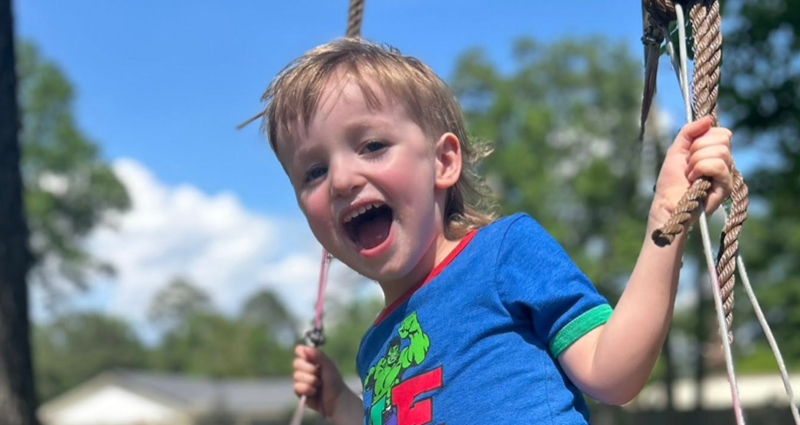
Two weeks earlier, Axel had been a healthy, happy toddler. Today, at 4 years old, he’s thriving again. The story of how he got here begins with a few small signs that were easy to miss.
A Thirst That Wouldn’t Quit
Axel was born healthy and growing right alongside his peers. So when he started asking for drink after drink, his parents didn’t think much of it at first. He’d always loved his juice.
“He was thirsty all the time. We could not give him enough to drink,” Annie says. “At first we didn’t think anything of it, but then it became, ‘OK, this is not normal.’”
His pull-ups told the same story. Axel was soaking them so heavily that they would fall off, and the urine had an unusual smell. After about a week, his parents also noticed he had lost a significant amount of weight, and fast.
Then one night, Axel woke up vomiting. His breathing didn’t sound right.
“Ben and I looked at each other and said, ‘We’ve got to get him to the doctor. Something is wrong,’” Annie remembers.
Annie turned to the internet and searched his symptoms. The answer that kept appearing was diabetes.
“We thought, no. He’s 2. It doesn’t run in our family,” she says. “Then my husband noticed a weird smell on his breath. It was literally all the symptoms, and it happened in just a couple of weeks.”
From a Clinic Visit to the ER
Axel’s regular pediatrician was booked, so Annie took the first appointment she could find. A pediatrician in Monroe was able to see him right away.
The pediatrician found glucose in Axel’s urine and sent him for bloodwork right away. The results showed a blood glucose level around 400. A typical range for a child is roughly 70 to 140. The family was told to go straight to the emergency room.
By the time they arrived at St. Francis, Axel’s blood sugar had climbed to 600.
The St. Francis emergency team confirmed what his parents feared. Axel had Type 1 diabetes, and he was in DKA, a dangerous condition that develops when the body can’t get energy from sugar and starts breaking down fat too quickly. Without fast, specialized treatment, it can become deadly.
One System, One Mission
Once St. Francis stabilized Axel, the team arranged for him to be flown to FMOL Health | Our Lady of the Lake Children’s Hospital in Baton Rouge, where pediatric specialists were ready and waiting.
That swift handoff is what connected care looks like. St. Francis and Our Lady of the Lake are both part of FMOL Health, and for Axel, that meant two teams in two cities working as one to get a critically ill child the care he needed.
When his parents finally arrived in the early morning hours, Axel was already settled in.
“They had him hooked up and he was asleep, getting fluids and everything he needed,” Annie says.
The next morning, the real work began.
Learning to Do an Organ’s Job
Type 1 diabetes is an autoimmune disease. The body’s immune system attacks the cells in the pancreas that make insulin, the hormone that moves sugar from the blood into the cells for energy. Without insulin, sugar builds up in the bloodstream. There is no cure, and it isn’t caused by diet or anything a parent did.
For Axel’s family, it meant learning to do the job his pancreas no longer could.
Over about a week at our children’s hospital, the Prewitts learned to count carbohydrates, calculate insulin doses and check Axel’s blood sugar with finger sticks every three hours. They learned to give insulin with a pen, and they learned what to do when numbers ran too high or too low.
“We were just like, ‘What? How can this be happening right now?’” Annie says. “There were a lot of emotions, and it was a lot of information. But they were so good at making sure we had the best understanding and what we needed to know to go home.”
Some lessons surprised her.
“I didn’t realize how much math goes into having a meal,” she says.
A New Normal That Fits
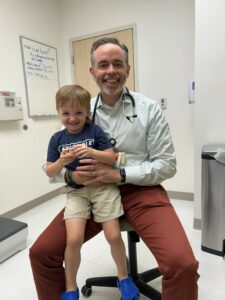
Before they left the hospital, pediatric endocrinologist James Gardner, MD, made a promise that felt impossible at the time.
“Dr. Gardner told us it would become part of our day-to-day routine, that it would blend in,” Annie says. “I thought, how? But it has. We have a routine.”
That routine looks very different today than it did two years ago. After a year of insulin pens and finger sticks, Axel moved to an insulin pump. He also wears a sensor on his arm that tracks his blood sugar around the clock. The pump is changed every three days, and it automatically doses and corrects insulin based on his levels.
“We prefer that over multiple shots a day,” Annie says. “It’s a lot more manageable, and since he goes to daycare, it makes life better for everybody involved.”
Axel still has a few curveballs to manage. Every child’s body reacts to food differently, and his family has learned his patterns through careful attention.
“We do not deprive him of anything. He can eat what he wants, but we’ve had to learn how different foods affect him,” Annie says. Illness, heat and activity can all shift his numbers, too. Just last weekend, a case of strep throat sent his blood sugar on a ride.
The family didn’t carry that load alone. Grandparents, relatives and friends who babysit or host Axel for a sleepover all learned how to care for him.
“Everyone was absolutely willing to learn and help,” Annie says. “He has a really great support system.”
That support system includes his care team in Baton Rouge. Even with the long drive, the family has chosen to keep Axel’s care with Dr. Gardner. They visit in person every six months, with virtual appointments in between.
“It’s quite a trip,” Annie says. “But we love Dr. Gardner and Dr. Gardner’s team.”
Stronger Than He Knows
Axel will turn 5 in January. He loves Paw Patrol, Bluey and Peppa Pig. He loves playing outside and riding his bike, and he really loves VR games, though those are saved for weekends.
Earlier this year he took the field as an FMOL Health | St. Francis Warhawk of the Game, where he threw out a pitch and soaked up the cheers.
He also does his own finger sticks.
“He’s so much more resilient than we are,” Annie says. “It was devastating to us at first. I had never heard of a child having Type 1 diabetes. I never knew it was a thing. But he has learned, and he’s so strong.”
October 17 marks two years since Axel’s diagnosis. The little boy who once left Monroe by helicopter is now living his life to the fullest, one carb count, one bike ride and one brave finger stick at a time.
What Every Parent Should Know
Type 1 diabetes can develop at any age, in any family, even without a family history. Early symptoms can look like ordinary toddler behavior, so it helps to know the warning signs:
- Extreme thirst or hunger
- Frequent urination, including heavy diapers, soaked pull-ups or new bed-wetting
- Sudden, unexplained weight loss
- Fruity or unusual-smelling breath
- Nausea, vomiting or stomach pain
- Fast or labored breathing
- Unusual tiredness or irritability
If your child shows these signs, call their pediatrician right away. If they’re vomiting, breathing differently or seem very sick, go to the nearest emergency room.
For families facing a new diagnosis, Annie offers hope that comes from experience.
“You’ll learn how strong you are,” Annie says. “So many people have asked my husband and me, ‘How do you do it?’ You’d be surprised what you can do when you have no choice. Be patient, and learn as much as you can.”
Most of all, she says, don’t walk this road alone.
“There are so many people in the Type 1 community, whether they’re newly diagnosed or have lived with it for years,” Annie says. “You can find them online and right at home. Find your people.”
Learn more about pediatric endocrinology services across our health system. Connect with a best-in-class primary care provider near you:
-
Find a pediatric provider in Acadiana.
-
Find a pediatric provider in Bogalusa.