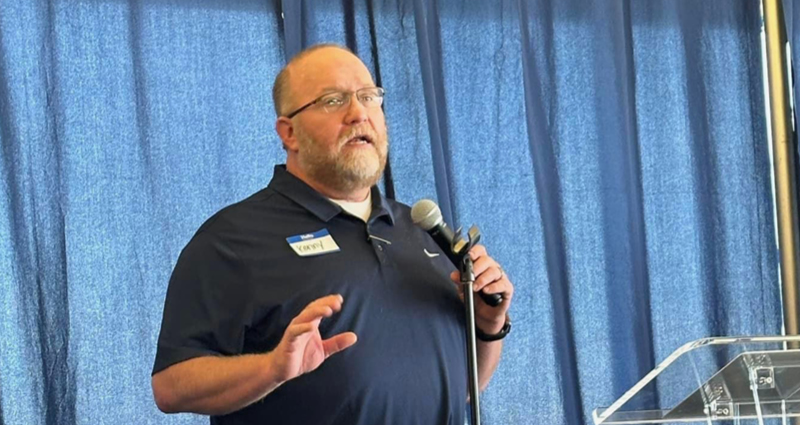
The day Kenny Strong walked into his gastroenterologist’s office, he wasn’t expecting much. Some back pain. Maybe a blockage. He figured he’d get a few answers and head home.
Instead, the doctor took one look at him and sent him straight to the emergency room at FMOL Health | St. Dominic in Jackson.
That visit would stretch into 49 days. And it would change everything.
The Moment Everything Shifted
Kenny, 54, is a big man, 6-foot-3 with a presence that fills a room. But when he arrived at St. Dominic’s, he weighed 408 pounds, heavier than he had ever been. His body was holding an enormous amount of fluid it simply could not manage on its own.
Then something happened that Kenny still shakes his head about.
One of the first doctors he encountered at St. Dominic’s was a former student. Cardiologist Michael Gary, MD, had played junior high football for him.
“He told me the story of me talking to them about their grades,” Kenny says. “I used to tell my players, ‘One day you’re going to be my doctor and my lawyer.’ That came true. What were the odds?”
He knew he would get great treatment. He was right.
Within 10 days in the ICU, Kenny shed 110 pounds of fluid as his care team worked to stabilize him.
Fighting for His Life
From the ICU, Kenny moved to the cardiovascular ICU, where John Calhoun, MD, cardiothoracic surgeon with St. Dominic’s and the Mississippi Heart and Vascular Institute, took over his care. Before one procedure, Kenny hugged his wife, embraced his family and told each of them he loved them. He fully expected to wake up and see them soon.
Instead, he came to more than two weeks later, strapped to the bed, unable to speak through a tracheostomy tube, so heavily sedated that his care team would later have to explain what had happened. He had struggled to come off the ventilator. Doctors placed an Impella device to support his heart. On day 25, Dr. Calhoun performed a triple bypass.
Through every one of those days, his wife, Shannon Taylor Strong, was there. She drove two hours each way, every day, to sit at his bedside. Most days, Kenny had no idea she was in the room. She came anyway.
“She is an angel,” he says.
Somewhere in the weeks of sedation, Kenny’s mind went to dark places. Later, as his head cleared, he began to recognize the faces that had appeared in those dreams. They were the nurses and staff who had been fighting for his life all along.
“They were in my process of being saved,” he says.
One nurse, a man Kenny had once coached against in junior college football, refused to let him give up.
“He told me, ‘You’re tougher than this. You want to lay in that bed the rest of your life? You’ve got to start moving,’” Kenny says. “That’s what I needed.”
Around him, a team of nurses showed up with exactly what he needed, some with a gentle word, others with the kind of firm, loving push that only comes from people who truly care. In the CVICU, nurses Rikki Michelle, Dustin Williams and Austin Luong became a constant presence, the kind of caregivers Kenny says he can never thank enough. Stuart Magee, Ron Eller, Mary Holly Lott, Hannah Vickers, Brittany Spencer, Sidney Wells and Leslie Dees met him with the same steady skill and patience, shift after shift. Tripp Harkins, Brad Hedgepeth and David Boydston were there, too, part of a team that refused to let him slip away.
As strength slowly returned, so did the hellion in him. Labeled a fall risk and issued red slippers, Kenny would stroll confidently past the nurses’ station as if he owned the place.
“I thought I was being sneaky,” he says with a grin. “I was that guy.”
On day 49, Kenny walked out of St. Dominic’s.
A Life Worth Coaching Toward
What Kenny was walking back to says a lot about who he is.
For most of his adult life, Kenny taught and coached across Alabama and Mississippi. Friday night football, early morning film sessions, the kind of relationship-building that stays with young men long after they leave the locker room. His last season at St. Joseph Catholic School in Greenville, where he served as defensive coordinator, ended with a state championship.
He grew up in the mountains of North Alabama, met Shannon in the Mississippi Delta, and built a family rooted in loyalty and faith.
His son now coaches at a local junior college. His daughter just graduated high school and attends the same school on a cheerleading scholarship.
Kenny had stepped away from coaching partly to be present for her. “I’d have had my back to her at games on Friday nights,” he says. “I wouldn’t have seen her at halftime.” So, he chose to watch her dance.
He’d also lost his father about a year before his hospitalization. That loss, combined with so many days in a hospital bed, sharpened something in him.
“You don’t always have tomorrow,” he says quietly. “I’m not always great about it, but I know.”
Giving Back, Going Forward
Since leaving St. Dominic’s, Kenny has stayed close to the people and the place that saved his life. He served on the St. Dominic’s Patient Advisory Council for about a year, returning often for appointments and stopping in to visit the CVICU team who cared for him.
Ask him about his recovery, and he’ll quickly turn the spotlight back on them.
“I wouldn’t be here without all of them and the outstanding cardio unit and staff of St. Dominic,” he says. “They are all special heroes in many people’s lives. I am just one man that went through a health issue.”
He knows there are more names than he can recall. “I don’t remember all of their names, but I do remember all of their love, patience, care and skill,” Kenny says.
He stays connected with former players and assistants, cheering them on as fathers, coaches, professionals and community members.
This June he began a new chapter at Delta Academy in Marks, Mississippi, back in education, back to leading young people, back to the work that defines him.
“It’s not about ring chasing,” he says. “It’s about leading young men.”
Kenny calls what happened at St. Dominic’s a second chance, given “through these people’s hands and hearts and kindness.” His cardiologist was once a boy he coached. The nurses who pushed him hardest became people he calls friends. His wife never left his side. And the care team that walked with him through 49 of the hardest days of his life gave him back the ones that matter most.