For many of us, bubbles bring to mind childhood afternoons, bubble wands and the simple joy of watching the shiny, translucent spheres float through the air before bursting.
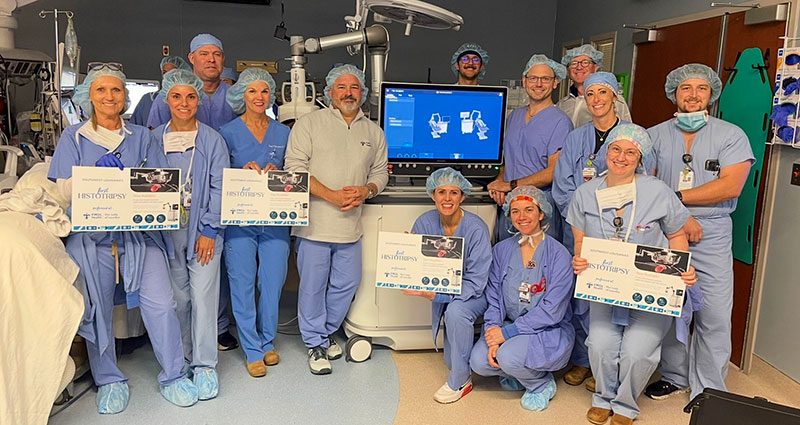
At FMOL Health | Our Lady of Lourdes, bubbles are taking on a remarkable new role in the fight against cancer. On October 30, 2026, surgical oncologist Henry Kaufman IV, MD, performed the first Histotripsy treatment in Southwest Louisiana, introducing a technology that uses pulsed sound waves to create “bubble clouds,” which destroy liver tumors without making a single incision.
With the first Histotripsy treatment in Southwest Louisiana, Our Lady of Lourdes and FMOL Health are continuing to bring emerging technology and specialized cancer care to the communities they serve. A cancer surgeon for more than 30 years, Dr. Kaufman witnessed tremendous advances in how physicians treat cancer. From the introduction of minimally invasive procedures to the rise of robotic surgery, he watched technology reshape what’s possible in the operating room.
Histotripsy represents another significant step forward, one that Dr. Kaufman considers among the most promising technological advances of his career. For patients across Acadiana, it brings new possibilities for treating liver tumors, particularly for those tumors that sit too close to critical structures to be safely removed. The no-incision procedure also may be considered for patients who face health challenges that make traditional surgery especially risky.
“Histotripsy is another high-tech, minimally invasive, effective treatment modality that we are adding to our arsenal in our fight against cancer,” Dr. Kaufman explained. “It is important that patients have access to cutting edge technology and state-of-the-art care in Acadiana without having to travel.”

Opening Doors for More Patients
Throughout his career, Dr. Kaufman cared for patients whose treatment options were limited by the state of their health or the location of their tumors. Some liver tumors sit too close to critical structures to be safely removed. Some patients just were not well enough to endure the toll a traditional, invasive surgery involving an incision takes on the body. Or, their condition made general anesthesia a serious concern.
Histotripsy gives physicians another option to consider in these situations.
Because the procedure utilizes ultrasound technology, patients avoid surgical incisions and the recovery associated with them. Most treatments take three hours or less, and many patients can return home the same day or the following day. That can mean less time in the hospital and a quicker return to everyday life.
Dr. Kaufman also sees potential for Histotripsy to play a role in more complex treatment plans. In some cases, treating part of a tumor may help make a future operation possible. Patients may also be able to continue chemotherapy, immunotherapy, or other treatments as part of their care.
Researchers are even studying whether the way Histotripsy breaks apart tumor cells could help the body’s immune system recognize cancer. While that possibility remains under investigation, it adds to the growing interest surrounding the technology.
How Tiny Bubbles Take on Tumors
The idea sounds almost too simple. Focus sound waves on a tumor, create microscopic bubbles and let those bubbles do the work.
That’s essentially the science behind Histotripsy, an FDA-cleared procedure that uses focused ultrasound waves from an external device to break apart liver tumors inside the body.
During treatment, physicians use the Edison® System, developed by HistoSonics to pinpoint the tumor in real-time with diagnostic ultrasound imaging and determine the threshold voltage needed to successfully remove the lesion. The device delivers carefully directed pulses of sound energy that create a cloud of tiny bubbles within the targeted tissue.
As the bubbles rapidly expand and collapse, they generate enough force to break apart the tumor cells. The process turns the targeted tissue into a liquid-like material that the body gradually clears away.
The procedure also works without heat or radiation, giving physicians another approach to treating tumors in a particularly complex part of the body, Dr. Kaufman noted. But, what makes the technology especially exciting is its precision.
“The accuracy of the device is remarkable, down to fractions of a millimeter,” he explained. “The mechanical forces destroy cancer cells while leaving adjacent critical structures, such as major blood vessels and bile ducts, intact. Unlike other, more invasive treatment modalities, Histotripsy can be performed as an outpatient procedure.”
A New Chapter in Cancer Care for Acadiana
Dr. Kaufman spent three decades watching surgical technology evolve, but experience also taught him to approach new devices with careful consideration.
He recognizes that promising early results don’t always translate into lasting improvements in patient care. Only a handful of innovations made a particularly strong impression on him throughout his career, including advanced laparoscopic surgery, robotic surgery – and now Histotripsy.
Bringing that technology to the Our Lady of Lourdes JD Moncus Cancer Center reflects a continued commitment to adopting advances that can make a meaningful difference for patients.
“The addition of histotripsy is another example of our adoption of state-of-the-art technology and evidence-based medicine in our ongoing fight against cancer,” Dr. Kaufman says.
Histotripsy joins a comprehensive range of cancer treatments already available at Our Lady of Lourdes, including robotic surgery, radiation therapy, chemotherapy and immunotherapy. Its arrival gives physicians another way to tailor care to the needs of each patient.
It also means families across Acadiana have access to this advanced treatment without traveling to another part of the state.
“It is important that patients have access to cutting-edge technology and state-of-the-art care in Acadiana without having to travel,” Dr. Kaufman says. “Our ability to offer this advanced technology represents a significant convenience to some patients, but, perhaps more importantly, it allows us to provide access to patients who cannot travel far from home.”