
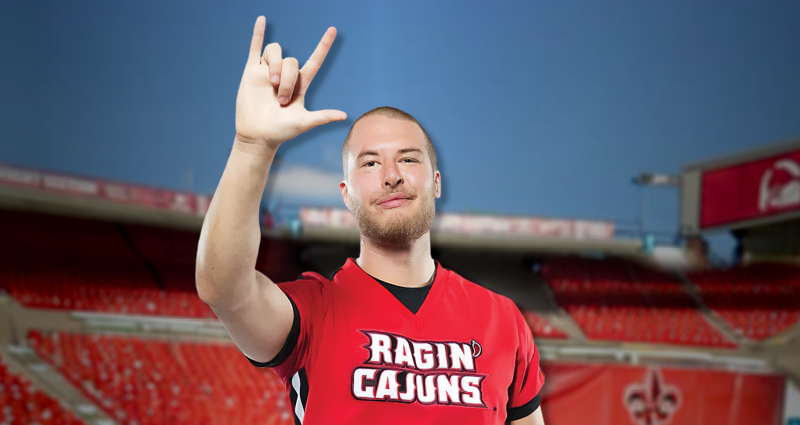
Isaac Cortez grew up knowing his face moved differently than everyone else’s.
Born with an incomplete congenital facial paralysis, the right side of his face never fully smiled. Doctors could not offer clear answers about why it happened, only that the nerves on one side of his face did not function the way they should.
“I couldn’t smile,” he recalls. “I could only frown. The lower part I could move, but nothing on the upper part up to my forehead and halfway up my cheek.”
In his small hometown of Basile, La., the condition became part of who he was. Everyone knew Isaac. There was rarely a need to explain himself, and over time, he learned to own it. He wrestled in high school, becoming a three-time state champion. He built a reputation for confidence, humor and resilience.
“It never affected me in a negative way. That was half my material for jokes,” Isaac says with a laugh.” There’s not an option for you to tell me something about my face that I didn’t already have something ready to go back.”
It wasn’t until college that he found himself explaining his condition more often. New classmates asked questions, and he started asking his own.
Still, the condition never slowed him down. If anything, Isaac kept finding new ways to push himself further.
A Cheerleading Injury That Changed Everything
After high school, Isaac enrolled at the University of Louisiana at Lafayette. Looking for something new during the quieter months of the COVID era, he stumbled into cheerleading. What started as curiosity quickly became passion. He earned a spot on the UL cheer team, then later transferred to LSU to cheer during the Tigers’ 2023 football season.
 During a practice in early 2024, everything changed. Isaac took an elbow to the face that split his eyebrow open. He was sent to J. Michael Robinson, MD, FMOL Health | Our Lady of the Lake sports medicine doctor and LSU team physician, who stitched him up and noticed something familiar in Isaac’s chart.
“He tells me he knows someone who works for a team at Our Lady of the Lake that does that specific surgery,” Isaac remembers. “He said he could set me up with a consultation if I wanted.”
For the first time, there was a realistic option on the table. Within weeks, he met with specialists at Our Lady of the Lake. What had once felt theoretical suddenly became possible. The timing was rare, and the opportunity unlikely to come again.
“I had thought about it for a long time,” Isaac says. “But this was never going to pass by me again. So, I went for it.”
A Complex Surgery and a Long Recovery
Isaac’s surgery took place in February 2024, just after cheer competition season. It was his first surgery ever, and it was not a small one. The procedure involved transferring a muscle from Isaac’s leg to his face, along with its blood supply and nerve connections. It lasted more than 15 hours and required a multidisciplinary surgical team from the Our Lady of the Lake Head and Neck Center.
Rula Mualla, MD, otolaryngologist, took the muscle from Isaac’s leg, Erick Sanchez, MD, reconstructive plastic surgeon, harvested the nerve from the leg, and Laura Hetzler, MD, reconstructive plastic surgeon, facial plastic surgeon and otolaryngologist, connected the muscle and nerve to Isaac’s face.
When connecting the muscle to Isaac’s face, Dr. Hetzler had a video of him smiling on loop in the operating room so she could tailor the muscle and nerve to match the left side with the newly formed right side. Because Isaac was young, Dr. Hetzler and her team used two nerve strategies to power the new smile, one driven by jaw movement and another designed to eventually create a more spontaneous, natural expression.
“It gives him a little bit of elegance and spontaneity over time,” she says.
Recovery was demanding. Isaac woke up with multiple incisions on his face, leg and calf. Walking again proved harder than he expected, both physically and mentally. After experiencing nerve pain the first time he stood after surgery, Isaac says he was afraid that pain would return every time he tried to walk again, which led to not being able to stand. In addition to strengthening his body, he had to retrain his mind that he could do physical activities again. That required help from his teammates.
“In cheerleading, people will get mental blocks on their (back flips) and they refuse to go backwards to do anything. And it was literally the same exact thing,” he says. “I had to have two people hold me up, and I pretended to walk on the air. Then they just lowered me on the ground and I started walking. It was like magic.
Throughout his hospital stay, Isaac leaned on his family and the care team around him.
“My nurses were phenomenal,” he says. “Every nurse I had was amazing. I can’t rate my hospital stay high enough.”
Learning to Smile Again
After surgery, patience became the hardest part. Nerves heal slowly, and for months, there was no visible movement. Then, right on schedule, something changed.
“I don’t think I got movement until almost July,” Isaac says. “They told me it would take about six months, and that’s pretty much exactly how long it took.”
Dr. Hetzler recalls a moment that still stands out.
“When he came in for his post-op appointment and we saw movement, his mom burst into tears,” she says. “She said, ‘I’ve never seen my baby smile.’ It was a beautiful moment.”
Progress came gradually. Isaac noticed it most when he returned home and saw people who had not seen him in a while.
“They’d tell me it looked a lot better,” he says. “That was always very encouraging.”
Interestingly, Isaac never needed formal facial physical therapy. Talking, eating and living his life did the work for him.
“They told me I talk so much and eat so much that it kind of fixed itself,” he says with a laugh.
Life Now and Looking Ahead
Today, Isaac is still cheering, still studying and still pushing forward. He completed his undergraduate degree in insurance and risk management, returned to UL for his master’s degree and continues to cheer competitively.
“I really wanted to keep cheering,” he says. “You’ll never be able to do this again, so do it until the wheels fall off.”
His smile is not perfect, and he is quick to acknowledge that. Scars remain, and subtle movements still differ when he is talking. But the change is undeniable.
“I don’t get asked nearly as much as I used to,” Isaac says. “People ask more about the scar now than the paralysis.”
When he thinks about others who may be facing similar decisions, Isaac does not hesitate.
“I cannot wait to rave about it,” he says. “I’d tell anyone with the same thing to try this out.”
The Facial Nerve Disorders Clinic at Our Lady of the Lake
Isaac’s care is part of a larger mission at Our Lady of the Lake. The Facial Nerve Disorders Clinic treats patients with facial paralysis and other facial nerve conditions caused by congenital differences, trauma, cancer or neurological disorders.
“We take care of all types of facial motor disorders,” Dr. Hetzler explains. “It’s not just paralysis. It’s recovery, reconstruction and long-term care.”
While these surgeries may be rare for patients, they are a core focus for the team. Dr. Hetzler notes that the clinic serves patients from across the country and beyond.
“We have patients from Alabama, Florida, North Dakota, even from India,” she says. “This is what puts us alongside places like Harvard, Cleveland Clinic and Johns Hopkins. We’re doing that work here.”
For Dr. Hetzler, the technical challenge matters, but the human impact matters more.
“The smile is the thumbprint of your personality,” she says. “Being able to give someone that back, to let them walk through the grocery store and feel normal again, is incredibly fulfilling.”
For Isaac, the journey has been about more than a smile. It has been about possibility, timing and a door opening when he least expected it.
“I could not have been in a more perfect situation to get it done,” he says. “Everything lined up.”
And now, when Isaac smiles, both sides of his face finally move with him.