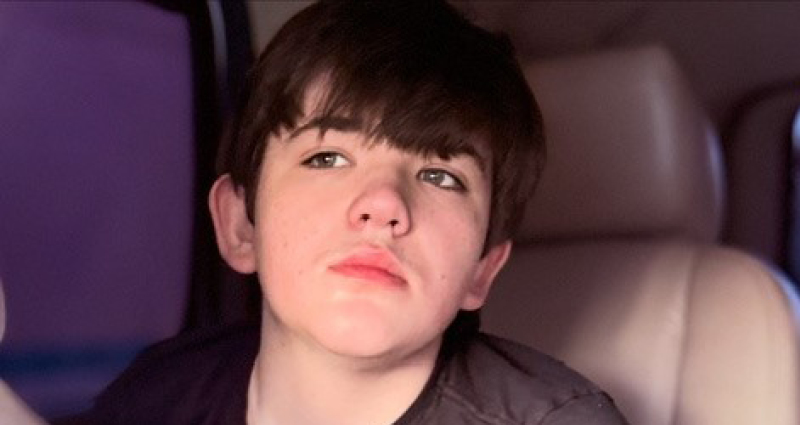
Tyler is many things these days: a seventh-grader, a Minecraft city builder, an Angry Birds expert and, as his mom Jessica Chappell will tell you with a laugh, a preteen who often needs to be asked to stop talking.
It’s a milestone that once felt impossible.
Diagnosed with autism as a toddler, Tyler was completely nonverbal at age 3.
“I can cry about it, which I did, or I can put on my big girl panties, and we can rock this,” Jessica remembers telling herself in those early days. “And at that moment, it was like, this is what we’re going to do.”
Early Intervention and a Voice Found
After official assessments confirmed the diagnosis, Tyler began Applied Behavior Analysis (ABA) therapy, a structured, evidence-based approach focused on communication, behavior and daily living skills. Early intervention became the family’s north star.
Jessica, who has worked at FMOL Health | St. Francis Medical Center for more than two decades, immersed herself in learning everything she could.
“I finally had to quit worrying about tomorrow,” she says.
Over the next several years, that daily commitment paid off. Tyler went from being completely nonverbal to expressing himself confidently. He met his therapy goals and graduated from ABA after five and a half years of steady progress.
Life felt stable. School was going well. Social skills were growing.
But autism, Jessica says, doesn’t disappear.
A New Season: Middle School and a “Perfect Storm”
Now approaching his 13th birthday, Tyler is navigating something entirely new: adolescence.
“It’s autism plus preteen hormones,” Jessica says. “It’s like a perfect storm of emotions, and he doesn’t always know what’s going on.”
After a move from the home he grew up in and a transition to a new school, Jessica began noticing behavioral changes. Some skills that had once felt solid seemed shaky again. Frustration bubbled up more quickly. Transitions became harder.
“I wish someone would have told me that just because they graduate from therapy the first time doesn’t mean you won’t need it again,” she says. “It’s 100 percent OK to go back.”
Because Tyler is older, fewer clinics could serve him. After months of searching, he began ABA therapy again earlier this year at Aurora Behavior Analysis.
“It turned out better than I could have imagined,” Jessica says. “We’re already seeing the social skills come back.”
Tyler now attends therapy four afternoons a week, easing back into structured support as he continues adjusting to middle school life.
Smart On His Terms
Academically, Tyler presents a unique profile.
“He’s so smart, especially in math,” Jessica says. “He can see and hear things and memorize them and give them back to you. But it’s on his terms.”
Recent changes in educational guidelines shifted Tyler from a self-contained classroom into a general education environment.
“Sitting in a classroom eight hours a day with a regular curriculum, that’s hard,” Jessica says. “But we’re doing the best we can.”
At home, his interests are intense and joyful. Conversation flows freely, something Jessica once feared might never happen.
“I probably say once a day, ‘Tyler, stop talking for a second,’” she says with a smile. “And there was a time I would have given anything to hear him talk.”
A Complex Medical Journey
In addition to autism, Tyler has epilepsy and a sleep disorder, conditions that are not uncommon among children on the spectrum. He remains under the care of pediatric neurologist Aristoteles Pena-Miches, MD, with FMOL Health | St. Francis Medical Group, as well as a psychiatric nurse practitioner who manages his medication regimen.
After careful adjustments, Tyler is approaching a significant milestone: nearly two years seizure-free.
“We’ve gotten close before,” Jessica says. “But this time feels hopeful.”
In February 2023, Tyler underwent a tympanoplasty at FMOL Health | Our Lady of the Lake Children’s Hospital in Baton Rouge to repair a ruptured eardrum.
Jessica says the care team’s understanding of Tyler’s autism made a profound difference.
“They let me be there when he woke up,” she says. “I was on the stretcher with him. He was scared, pulling at the bandage. They were so patient.”
Follow-up visits revealed conductive hearing loss, another layer to navigate. For now, the focus remains on protecting the hearing he has and continuing coordinated specialty care.
The Caregiver’s Reality
If there is one theme that runs through Jessica’s story, it’s persevering with honesty.
“It’s not always rainbows and sunshine,” she says. “Change is hard. Teen years are hard. Add autism, and it can feel overwhelming.”
Her husband has been working out of town for extended stretches, leaving her managing most daily responsibilities on her own.
“You’ve got to have a tribe,” she says. “Even if it’s just one person you can call when you need a break.”
For Jessica, that support often comes from her parents. A few hours of separation can mean the difference between burnout and balance.
“Your mental health as a parent is just as important as the energy you’re putting into helping your child,” she says. “You have to take care of yourself, too.”
Day by Day
When Tyler was first diagnosed, Jessica worried about high school, adulthood, the distant what-ifs.
Now, she keeps her focus closer.
“Just live in the present,” she says. “Day by day.”
And some days, as she drops him off, Tyler says it first: “I love you, Mom.”
For Jessica, that’s a milestone worth celebrating no matter what tomorrow holds.
If you suspect your child needs an evaluation for autism, start that conversation with their pediatrician.