There are places where healthcare is more than a service. It’s woven into the life of a community.
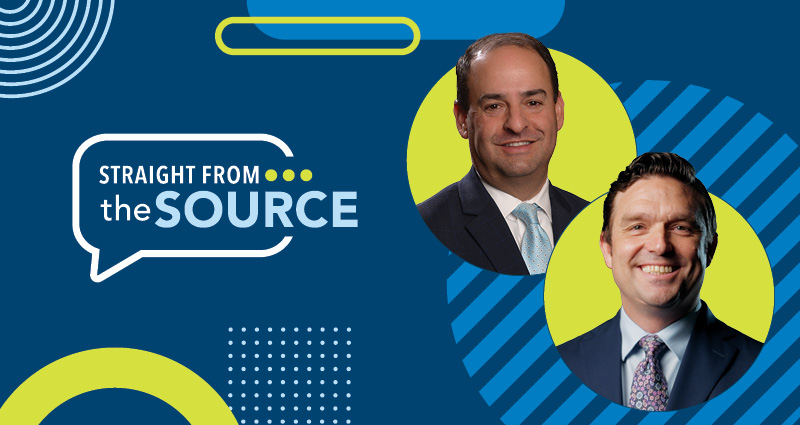
On this episode of Straight from the Source, Dave Estorge, FMOL Health vice president of rural strategy, and Emilio Russo, MD, FAAFP, department chair and associate professor of family medicine with LSU Health, talk candidly about rural health, the challenges, the hope and the relationships that make it all work.
The conversation isn’t just about beds, transfers or staffing. It’s about neighbors caring for neighbors, patients healing close to home and a health system committed to standing beside rural hospitals rather than overshadowing them.

The Strength of Rural Hospitals
Estorge has spent the last several years driving Louisiana and Mississippi back roads, walking hospital halls and meeting with rural leaders. What he sees is not smallness. It’s strength.
“These hospitals are the backbone of their community,” Estorge says. “They’re often the largest employer. And it’s very common for you to be taking care of your friends, neighbors and relatives in your community hospital.”
Those connections are exactly why he believes tertiary centers like FMOL Health’s hospitals carry a responsibility, not to compete, but to partner. Tertiary centers are larger hospitals that provide specialized, higher-level care.
“We have a responsibility to be an extension of the care they received at their community hospital,” he explains. “Not to have a relationship that is predatory.”
That philosophy shapes his strategy: accept transfers when needed, support local hospitals whenever possible, and, when patients are stable, help them recover back home.
Because home matters.
A Ministry of Relationship
Dr. Russo puts words to what many rural clinicians feel instinctively: that the heart of healthcare is relationship.
He reflects on a favorite Wendell Berry idea that “health is membership,” then adds, “Health is relationship.”
As a family physician, he says, patients are never just isolated cases.
“We see patients not as just individuals, but as members of a family and a community,” Dr. Russo says. “Their priorities change as their lives change, as all of ours change.”
That belief shapes how he thinks rural health should be strengthened. Technology, resources and systems matter, but relationships are the key.
“The solution to rural healthcare is right in front of us,” he says. “It’s relationships.”
A Simple Email Can Change the Tone of Transfers
Some of Estorge’s most meaningful work isn’t complicated. It’s human.
Every day he reviews transfer lists across the system. Then he sends a note to the CEO of hospitals that transferred patients. Not asking for anything, just saying thank you.
“The CEOs will get these emails and be like, what is going on here?” Estorge says. “I’ve never received an email like this before.”
Soon, the replies start coming in.
“They’ll say, ‘That individual is my pastor. Would you please go check on him?’ or ‘She worked at our hospital for 14 years. They’re like family. Would you tell them I say hello and put eyes on them?’”
Those moments change something deeper than workflow. They build trust.
“Once you do that,” Estorge says, “the next step is, ‘I really like these guys. What else can we work on together?’”
Training Physicians Who Know They Belong
At FMOL Health | Our Lady of the Angels Hospital in Bogalusa, rural health isn’t a concept. It’s daily life.
The LSU Rural Family Medicine Residency Program based there is intentionally designed so residents don’t just visit a rural community for a rotation. They become part of it.
“They don’t start in New Orleans or Baton Rouge,” Dr. Russo says. “They start there and they finish there. And that is really, really important.”
Over time, the town itself has become a teacher.
“I would argue that the best faculty member I’ve ever had is Bogalusa,” he says.
For Dr. Russo, training physicians in that environment shapes how they will practice for decades to come, grounded in community, connected to their patients and aware that care happens far beyond an exam room.
“Being connected to the community outside of the exam room is a really key part of our role as physicians,” he says.
A Transfer is Never Just a Transfer
Transfers are often talked about in terms of capacity or logistics. But in the episode, Estorge and Dr. Russo both reflect on the human side.
“When it becomes necessary for a patient and their family to go hundreds of miles away from home in a moment when they’re truly vulnerable,” Dr. Russo says, “this deserves our best effort and our most attentive care.”
Listening to rural ER physicians helped reshape how FMOL Health handles capacity. Estorge recalled a conversation where a doctor explained how often they called, heard “no beds available,” and hung up before a transfer was ever counted.
That led to the creation of a call-back approach rather than a quick “no.”
“We began to accept an extra patient per day,” Estorge says. “Think about what that means to those communities.”
Behind every number is a person, a family, a town waiting for news.
Across the system, new transfer center coordination along the I-10, I-12 and I-20 corridors is helping connect patients with higher levels of care when they need it and, whenever possible, return home to recover.
Supporting Families Who Travel for Care
Sometimes care still means leaving home, and when patients travel, families do too.
Estorge spoke about the importance of places like the Hogs for the Cause Family Support Home at FMOL Health | Our Lady of the Lake Children’s Hospital, and similar accommodations across the system including our Ronald McDonald Family Room at Our Lady of Lourdes Women’s & Children’s Hospital.
“You have to take the stress off these families when they travel for care,” he says. “The fact that you’re able to provide this type of service is a tremendous gift.”
Less financial pressure and more rest for families, he says, helps create “a better healing environment for that patient.”
What Comes Next
Both leaders are clear: the future of rural health depends on trust.
“We have to continue to build relationships with these hospitals and be genuine and authentic in our approach,” Estorge says. “When you build trust, the outreach starts to flow in the opposite direction.”
Those calls are arriving already, questions about transfers, staffing, even leadership transitions. And Estorge sees that as a sign of hope.
Dr. Russo sees hope too, especially in how seriously the state is beginning to take rural health challenges.
“It feels like maybe we’re getting the message in Louisiana in a new way,” Dr. Russo says. “Not just ‘the sky is falling,’ but that we have to think of this differently.”
Most importantly, he believes rural communities themselves must help shape the solutions.
“It’s critical that we enlist the expertise of those communities,” Dr. Russo says. “Somehow, they have an important part of the answer.”