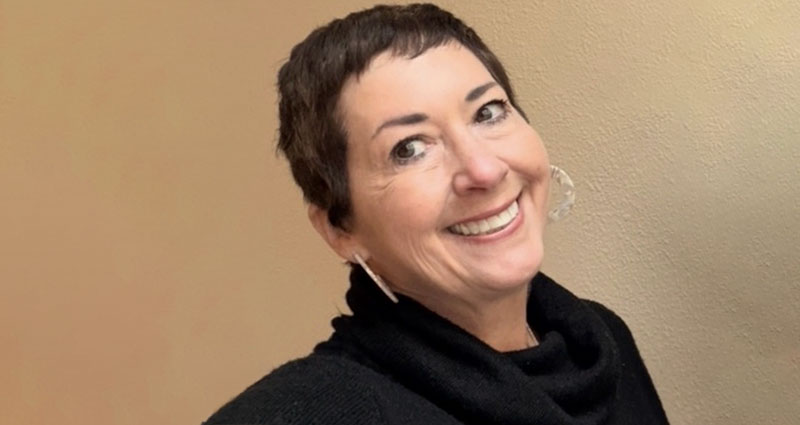
For years, Cabell Mouton had a quiet reason for delaying her first colonoscopy.
She was healthy. She exercised daily, ate clean and had never spent time in a hospital except to deliver her daughters. There was no family history of colon cancer. She kept up with mammograms and routine checkups — except for the colonoscopy that lingered on her to-do list.
“I was scared of the colonoscopy,” Cabell says. “I had no symptoms of any kind, so I put it off.”
She knew the recommended screening age was 50. She scheduled her first colonoscopy at 58.
In July 2024, she finally walked into the appointment she had avoided for eight years. What she feared was the preparation and the procedure. What doctors found was far more serious.
“They found a five-centimeter tumor,” Cabell recalls. “The diagnosis was malignant neoplasm of the rectum.”
The tumor, she was later told, may have been there for more than a decade. It could have been present when she first became eligible for screening.
“If I had waited another year or a year and a half, two years, this would not be the same story,” she says.
What began as a screening she dreaded became the moment that saved her life.
A Diagnosis and a Plan
After the initial colonoscopy, the first biopsy came back negative. A follow-up procedure that was expected to take less than an hour lasted more than two. Surgeons were unable to remove the entire mass, and a subsequent biopsy confirmed cancer.
Within days, Cabell was referred to colon and rectal surgeon Kelly Finan, MD, at FMOL Health | Our Lady of the Lake.
“Dr. Finan and her team treated me like a friend. They never talked to me about prognosis. They just went to work,” Cabell says.
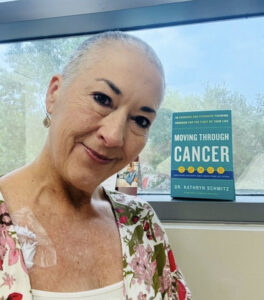 In October 2024, she underwent surgery to remove a portion of her rectum and colon and had an ileostomy placed. During surgery, doctors discovered the cancer had spread to nearby lymph nodes. She was staged at 3A colorectal cancer.
“When Dr. Finan called me and told me after my surgery that I had stage 3A colorectal cancer, before she even called me, she had already talked to the oncologist and had an appointment set up the next day,” Cabell says. “I never had to advocate for myself. I never had to knock and say, ‘Hello.’ Dr. Finan and her team took it and ran with it. They put me on a trajectory of what was going to happen next.”
That clarity gave her something steady to hold onto. She focused on each next step, from surgery to chemotherapy to recovery. In November 2025, Dr. Finan reversed her ileostomy. Follow-up scans have been clear.
Care That Felt Personal
Cabell describes her care at Our Lady of the Lake as seamless and deeply personal. From the start, she felt surrounded by a team that moved quickly and communicated clearly.
“They would make the appointments for me, and I would just show up. And I did everything that they said to do,” she says.
Moments of kindness still stand out. During chemotherapy, she had to go home with a portable infusion pump for 48 hours at a time. Dr. Finan’s sister-in-law, a handbag maker, handcrafted a bag for Cabell to carry her equipment.
“It has a tag in there with a heart that says, ‘Tougher than cancer,’” Cabell says. “After my treatment and after all the surgeries, I really miss seeing the care team.”
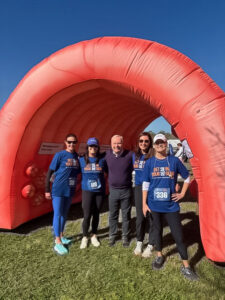
Last year, in the middle of treatment, she showed up at a local colorectal cancer awareness walk and began moving through the course. When she started to jog, Dr. Finan and her team noticed.
“We crossed the finish line together,” Cabell remembers. “That was amazing.”
Humility, Honesty and a New Perspective
Colorectal cancer is not always easy to talk about. It involves a part of the body many people prefer to ignore.
“Colorectal cancer is one of the most humbling things because not everybody wants to talk about that,” Cabell says. “But it’s something that I will have to deal with the rest of my life.”
She is candid because she wants others to understand both the seriousness of the disease and the reality of survivorship. She would not have chosen this journey, but she has found meaning in it.
“There’s nothing good about cancer, but there is goodness in healthcare and other people,” she says. “It has not been all bad.”
Today, she feels strong and energized. A former tennis professional, she’s back playing pickleball and doing body combat.
“I really feel like my best days are ahead,” she says. “I am full of health. Every cell in my body is vibrating with vitality and strength.”
Turning Fear Into Action
 Cabell knows firsthand how easy it is to delay a colonoscopy. She once did the same.
“Just because you think that you’re in the best shape of your life doesn’t mean that there’s not something that needs to be looked at to save your life,” she says.
When she talks to people who are hesitant, her message is practical and direct.
“The procedure of a colonoscopy, the preparation, the cleaning out of the system, you will feel so good,” she says. “The procedure itself is the best nap of your life.”
Her own experience has influenced those closest to her. Her husband, Mark, along with family members and close friends, scheduled colonoscopies after her diagnosis. She did not need to persuade them.
“I’ve never had to say, ‘You need to get a colonoscopy,’” Cabell says. “They saw what I went through.”
On March 28, she will participate in Get Your Rear in Gear at Pennington Biomedical Research Center in Baton Rouge, joining Our Lady of the Lake’s team to raise awareness about colorectal cancer and the importance of screening. The annual event encourages open conversations and promotes lifesaving tests like colonoscopies.
For Cabell, the event represents more than a walk. It is a reminder that the appointment she once feared became the reason she is here today.
“You do not want to go through what I just did,” she says. “That best nap of your life could save your life.”