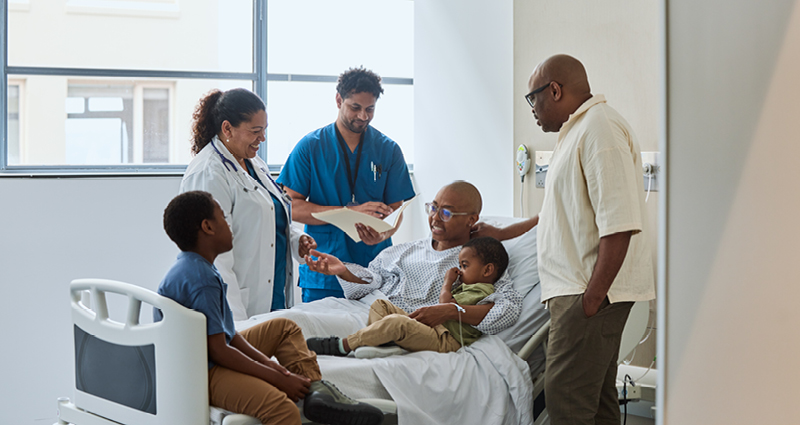
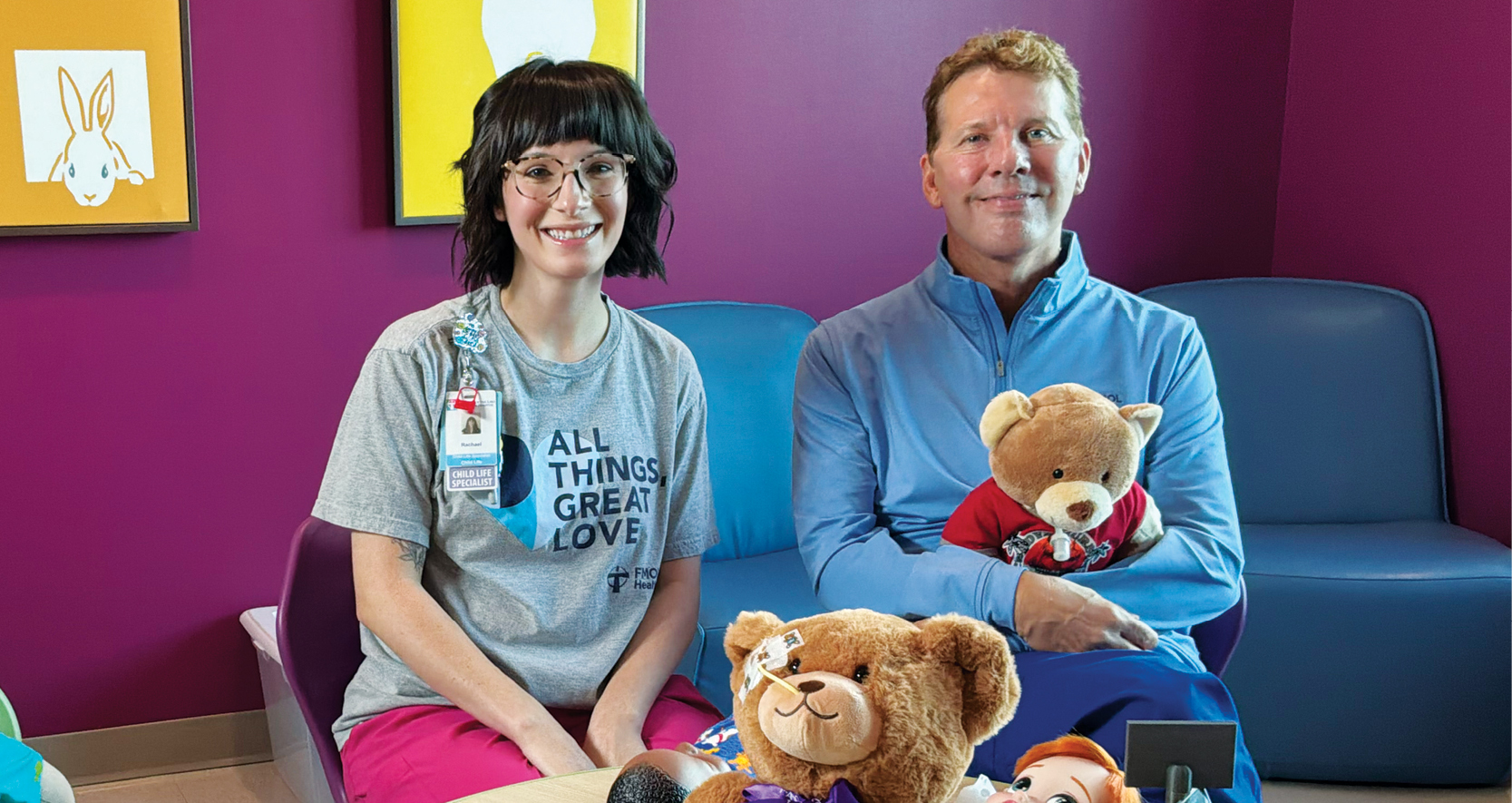
A little girl clutches a teddy bear while a Child Life specialist explains what an IV will feel like. A teenager slips on VR goggles and walks through a virtual safari instead of watching the needle go in. A family gathers at a bedside to press a baby’s hand into soft clay, leaving behind a shape they will hold onto forever.
It may not look like traditional medical care. But all of it is care.
When E.J. Kuiper, FMOL Health president & CEO, spent a day with the Child Life team at FMOL Health | Our Lady of the Lake Children’s Hospital, he came in with a general idea of what the work was.
“I had a pretty good understanding of what Child Life was,” he reflects. “But today I learned so much more.”
That’s because our Child Life team is about much more than play. Behind the toys, games and activities are trained Child Life specialists who help children and families understand, prepare for and cope with some of the most difficult moments of a hospital experience.

What Child Life Really Does
Ask a Child Life specialist what they do, and they’ll gently push back on the first assumption almost everyone makes.
“A lot of times people see Child Life and just see the play. You get to play with kids all day,” says Rachael Raney, a Child Life specialist at our Children’s Hospital. “And while play is obviously a big part of what we do, it’s always play with a purpose.”
That phrase is the heart of it.
Behind every game, doll or activity is a trained professional who understands child development, assesses what a child is experiencing in the moment and finds ways to meet that child where they are. The work spans procedural preparation, diagnosis teaching and anxiety support before a scan. In some of the hardest moments, Child Life Specialists walk alongside families through trauma, grief and loss.
“It’s so much more than just play,” Rachael says. “It’s really the full picture. All the different ways we’re able to provide support to our patients and families.”
Child Life is a clinical discipline. The toys are tools, and the Child Life specialists are experts.
Medical Play: Learning Through Play
One of the most powerful things E.J. witnessed was medical play. A child holds a doll or a stuffed animal and rehearses the very thing that frightens them: getting blood drawn, wearing a mask, lying still for a scan.
It looks simple. It isn’t.
“Whenever I’m doing medical play, I’m constantly assessing the child,” Rachael explains. “How they’re reacting to the tools, if they’re asking questions, what’s making them nervous and how to best support them in that moment.”
Medical play gives a child the chance to rehearse fear in a safe space. It also brings to the surface beliefs kids sometimes quietly carry.
Some children may believe they are sick because they misbehaved. They may see a painful procedure as punishment.
“Do they think they’re going through this painful procedure because they thought they were bad?” Rachael says. “Addressing those misconceptions is what’s going through my mind.”
That’s part of what makes Child Life different. The Child Life specialist isn’t simply distracting a child from what’s happening. They’re watching, listening and adapting the experience to help the child understand what’s happening and develop a way to cope.
Preparing Kids for the Scary Parts
Before a CT scan, an MRI or another imaging test, a Child Life Specialist prepares the child using language and explanations matched to their age and developmental level.
E.J. climbed into the CT scanner himself and received the same kind of child-friendly preparation a young patient might receive before an imaging procedure.
“My goal is for the child to understand, based on their age, why we’re doing this,” Rachael says. “Why we need pictures of their brain today. But also helping them understand everything they’re going to experience and addressing their worries and misconceptions.”
That might mean explaining what the machine will sound like, where a parent will be and what the child can expect to feel. The goal isn’t to promise that a child won’t be afraid. It’s to give them information, choices and coping strategies they can use when the unfamiliar becomes real.
A Toolbox Built Around the Child
Child Life has plenty of tools to work with, from Bravery Bugs and breathing cards to VR goggles and other distraction and coping strategies.
Many of those tools arrive as gifts. Donors make it possible for the team to keep VR goggles charged, Bravery Bugs on hand and shelves stocked with the toys, games and crafts kids reach for every day.
But the tools themselves aren’t the point. The Child Life specialist has to figure out which tool or combination of tools makes sense for that particular child.
“Every kiddo is different and has different needs,” Rachael says. “We’re constantly having to get creative with new interventions, different ways to offer distraction, different comfort holds. After every interaction, we take a mental note: this worked for this child. Maybe we can try it next time.”
There is no universal script. There is a Child Life specialist reading a young patient and responding, in real time, to what that child needs most.
Amazing Kids TV
In the studio that houses Amazing Kids TV, E.J. took a turn as Bingo caller, with a little help from Waylon and Lawson, two young co-hosts who kept things lively and honest. For what it’s worth, E.J. was fair and generous … and the kids still won.
“Monday through Friday at 11 and again at 2, we stream an activity,” says Katie Wood, Child Life assistant, who runs the studio. “Bingo, trivia, story time, a craft. Kids tune in from their rooms and participate with us. They love hearing their names. We give them a little shout-out.”
It sounds like fun, and it is. But it also solves something real.
“A lot of the kids here think they’re the only one,” Katie says. “I’m the only one who’s ever gotten an IV. I’m the only one who’s ever had an MRI. By doing this, they see there are other kids here, too.” It helps normalize healthcare for patients, and they know other kids are in the hospital, too.
Watching Waylon and Lawson play and laugh, call out their Bingo cards and chat about soccer is a reminder of something Child Life works hard to protect: the ordinary, joyful parts of being a kid, even inside a hospital.
The idea for the studio grew out of the pandemic, when playrooms closed and volunteers couldn’t enter isolation rooms. The team found a way to reach children who couldn’t leave their beds, and what started as a response to isolation became a lasting way to connect kids throughout the hospital.
Support from the Encourage Kids Foundation and FORE!Kids Foundation helped turn that idea into a working studio, from the equipment to the technology that carries each broadcast into patient rooms.
For Katie, the impact often shows up in the parents.
“I’ve had parents come up to me crying,” she says. “I haven’t seen my child smile in days, and now they won’t stop. Their whole mood shifts. It’s very rewarding.”
A Playroom Built for Purpose and the Community That Fills It
The playroom E.J. explored wasn’t simply stocked with toys. It was filled with tools designed to help children learn, cope, express themselves and prepare for medical experiences.
Among them are medical teaching materials like Butterfly Pig kits, which give children another way to learn and engage through play.
Butterfly Pig kits like the one Waylon and Lawson enjoyed came through gifts to the FMOL Health | Our Lady of the Lake Foundation, along with much of what fills these shelves. To the kids, it’s playtime. To the donors who made it possible, it’s a child learning to feel a little braver.
The hospital serves roughly 90,000 patients each year. “Any little bit can help change an experience here,” Katie says.
Therapy Dogs, Gardens and 40 Volunteers
Child Life’s reach extends well beyond the playroom.
E.J. met the therapy dogs, including a slobbery favorite named Jeaux Jeaux, who drew smiles from patients, parents and, by E.J.’s account, the team members most of all.
Child Life also coordinates around 40 volunteers, including pet therapy teams who visit twice a week, LSU master gardeners who bring horticulture therapy and teach kids about plants, and bedside volunteers who reach children to extend the services of the Child Life team.
Each volunteer offers another way to bring connection, comfort or a little joy into a difficult day.
The Part No One Sees
Most of E.J.’s day was full of joy. But he didn’t leave without understanding the weight this team carries.
Child Life specialists walk alongside families through some of the hardest moments a parent can face. For children receiving palliative care, Child Life specialists build trusting relationships over time, helping children understand what’s happening in ways that meet them where they are and giving them opportunities to express what they feel.
Much of that work is memory-making: journaling, art, hand molds and footprints that families can hold onto long after a child is gone.
Rachael shared a story from her training that still shapes the way she works. As a student, she helped a family make handprints and footprints with a baby during what she thought was a simple Halloween activity, little ghost feet. Afterward, her supervisor told her the baby’s prognosis was not good.
“It wasn’t just this little craft,” Rachael says. “It was making memories for the family to hold onto.”
That is part of a Child Life specialist’s work, too: helping families create tangible memories during moments they never imagined having to face, the death of their child.
“We have to compartmentalize,” Rachael says. “Those situations are so hard, but we push our emotions back because the parent is the one who needs support in that moment.”
Why Joy Is a Core Value
At FMOL Health, joy isn’t incidental. It’s something the team pursues with intention, because the work is genuinely hard, and the children genuinely need it.
“Some of these kids are going through year-long cancer treatments, in the hospital for months at a time,” Rachael says. “Anytime we can bring joy and bring light in a time that’s really hard, we love that we get to be part of those moments. And it’s for us, too.”
A birthday celebration. A Bingo win. A dog at the bedside.
These moments don’t erase what a child is going through. They give children and families space to experience something other than the hardest parts of it.
The people who do this work don’t carry it alone.
“We have a lot of moments of joy and laughter, but we also have moments where we cry and debrief together,” Rachael says. “We’ve all been in those moments and know how hard it can be.”
For Rachael — a mom of two boys with a third on the way — that culture is worth an hour-plus commute each way.
“I could not see myself working anywhere else,” she says. “We all come together with one goal: to provide the best possible support to these patients. You don’t find that everywhere.”
The Care Insurance Doesn’t Cover
Child Life is a non-billable service, so much of this work depends on people who choose to give. For four years, proceeds from The Big Bash helped fund Child Life team members, while Children’s Miracle Network Hospitals partners, the Spirit of Children Foundation and everyday shoppers who round up at checkout continue to add to that support.
“Any little bit can help change an experience here,” Katie says.
Play With a Purpose
By the end of the day, E.J. had a much bigger understanding of a Child Life specialist than when he walked through the doors.
“My main takeaway is how crucially important Child Life Services is for this hospital and the kids we serve.”
Behind every moment that looks like play is a purpose.
A frightening machine becomes something a child can practice for. A lonely child finds connection on a hospital TV channel. A family facing loss gets something tangible to hold onto. Much of it is made possible by people who will never see it happen, from longtime partners to shoppers who round up at the register.
And a child gets the chance to feel prepared, supported and brave.