Most patients never see the place where many of their answers begin. They feel the quick pinch of a needle, watch a vial fill and move on with their day. But between that moment and the result a doctor uses to make a decision, people, precision and care are already at work.
But between that moment and the result a doctor uses to make a decision, an entire world of people, precision and care goes to work.
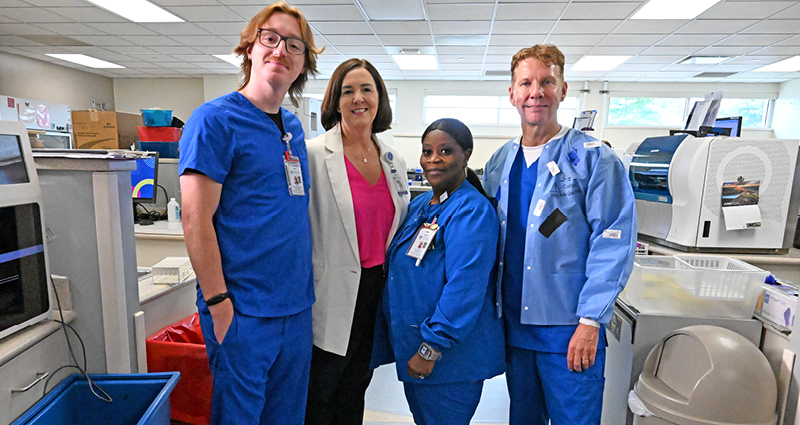
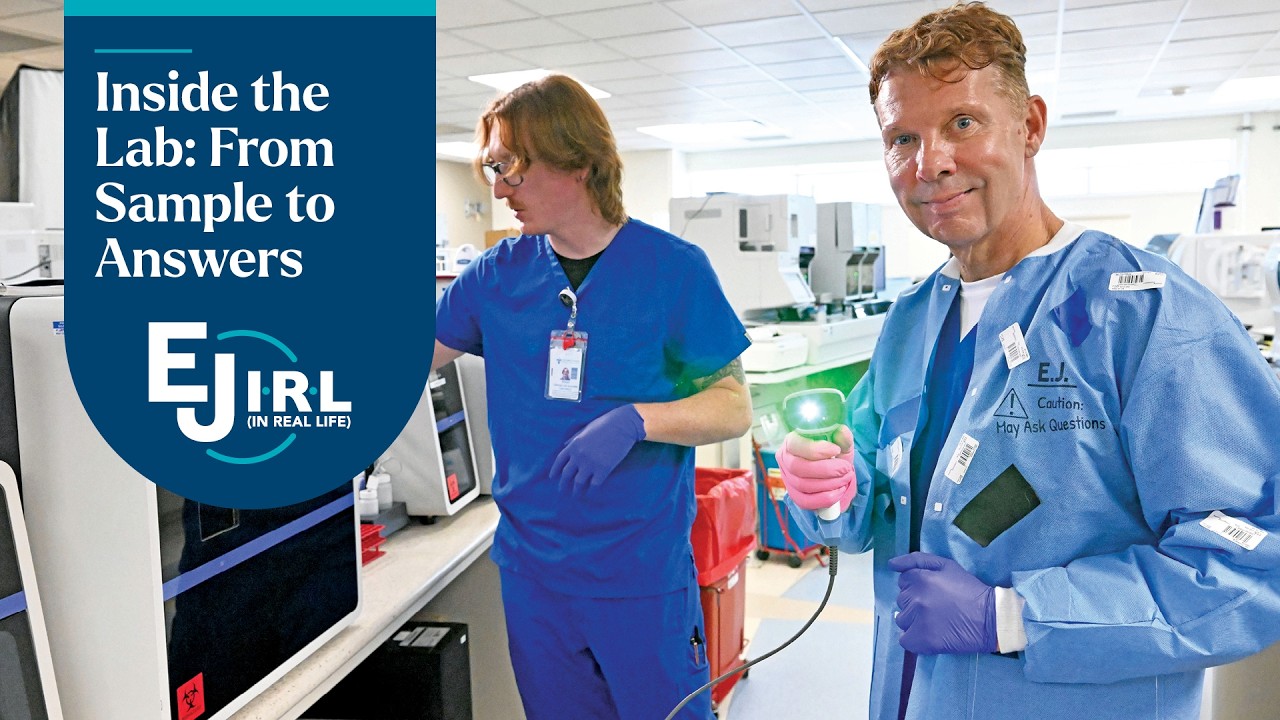
FMOL Health President and CEO E.J. Kuiper walked through that door during a day with the phlebotomy and laboratory teams at FMOL Health | Our Lady of Lourdes. He found a team that brings skill and deep care to work many patients never see.
Kind Hands
E.J.’s day started with Joyce Woods, a phlebotomist who has been drawing blood for 21 years and has spent the last three at Our Lady of Lourdes.
Her supply cart used to be a plain white box that, in her words, looked “like an ice cream truck.” So she started decorating it on her own, first for Christmas, then for every holiday after. Now patients look forward to seeing what the cart will look like next.
The decorations are not just for fun. They are part of how Joyce builds trust in the few short minutes she has with each person. When she walks into a room at 4 a.m. and turns on the lights, she never knows what she will find. Some patients are grateful. Some are frightened. Joyce meets all of them the same way.
“I have very kind hands,” she says. She leans in, lets the small cross on her chain catch a patient’s eye, starts a conversation and, before they know it, she is done. Her technique is gentle by design. She pulls the skin taut so the needle glides in smoothly.
Her heart shows up in the small things, too. She once came in on her day off just to draw one patient’s blood because he asked for her by name, the kind of quiet devotion that earned her a spot in a coworker’s story and a lasting place in patients’ memories.
Harder Than It Looks
Then it was E.J.’s turn. Joyce handed him a mannequin arm and walked him through finding the vein, setting the tourniquet and making the stick. He located the vein. He made the attempt. The draw came up dry.
E.J. is honest about the experience. Feeling for the vein is manageable, he says, but the full process is more complex than he expected. “It was beyond my skill set,” he says, laughing. “I’m glad we have the Joyces of the world.”
He also walked away covered in stickers, a habit lab team members pick up when there is no time to stop and no reason to slow down. As Joyce put it, “You just slap it on your scrubs and move on. We’ve got work to do.”
The Pneumatic Tube System
Before E.J. could set foot in the lab itself, clinical laboratory scientist Ethan Warren handed him a stack of binders: standard operating procedures covering every tube, every test and every safeguard the lab follows. Given five minutes to read, E.J. finished in four and a half, enough of an overachiever to earn a raised eyebrow.
The reading underscored a truth E.J. carried with him all day. The lab is far more complex than most people realize. These are professionals who train for years, follow detailed procedures, and keep every specimen safe and accounted for.
Ethan showed him how it all connects. Samples travel through a hospital-wide pneumatic tube system, similar to a bank drive-through but stretched across every floor. When the tubes converge and jostle for their turn, there is a brief traffic jam before each one drops to its destination.
Where Answers Start
Ethan explains what happens once a sample lands. Automation does much of the heavy lifting, but nothing reaches a patient’s chart until a person confirms it. “None of those results cross to the patient’s eyes before I get my eyes on it,” he says.
He treats each result like it belongs to a member of his family. That matters, because lab work plays a role in roughly 80% of diagnoses, often before a nurse or doctor sees the patient.
Nowhere is that clearer than with IntelliSep, an early sepsis detection test developed within FMOL Health. Sepsis is a race against time. About 87% of cases arrive through the ER, and without prompt care, the condition can become life-threatening quickly.
IntelliSep flags a patient’s risk in just 8 to 10 minutes, giving care teams a faster signal when every minute matters. It also helps spare patients who do not have sepsis from treatment they do not need, so resources can go where they matter most.
The People Behind the Puzzle
The day held a few surprises. Stephanie Manson, Our Lady of Lourdes president, stopped by to check on E.J., a reminder that these visits are as much about people as process. She and E.J. made a trip to the Our Lady of Lourdes Blood Donor Center, where a single powerful statistic stuck with him. One pint of donated blood can save three lives.
Left alone with the tube system for a moment, E.J. could not resist. He wrote a note, tucked it in a cylinder and sent it off to a random department to brighten someone’s morning. The message read, “From the Lab with Love, E.J.”
By the end of the day, E.J. kept returning to one idea. Patients meet the Joyces of the world. But so many others work behind closed doors, quietly shaping the care each person receives.
“There are a lot of great people that work in the lab that people don’t see,” he says. “But they’re doing really, really important work.”
Every result tells a story. This episode began with a blood draw and ended with a deeper appreciation for the people who make answers possible.