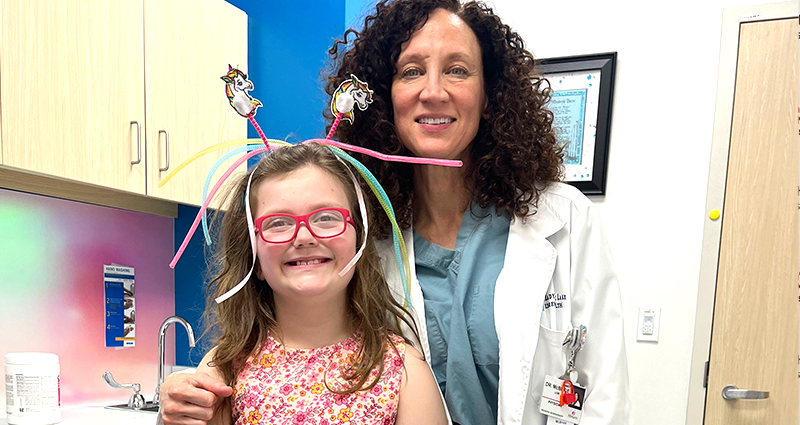
The day after second grade ended in May 2024, Katy was celebrating.
Awards ceremonies were behind her. Summer had just begun. She and her mom were heading out to lunch, a simple outing to mark the start of a carefree season.
They never made it to the restaurant.
An impaired driver crossed the center line on Highway 107 near Pineville, striking their car head-on and leaving 8-year-old Katy critically injured.
Miles away in Lake Charles, her grandmother Renee was in the middle of cooking when she noticed something unusual. Jessica’s phone had stopped on the map. It hadn’t moved.
“I figured her phone had dropped on the floor of the car,” Renee says.
Within minutes, the call came. And everything changed.
A Night No One Will Ever Forget
The injuries were severe.
Jessica suffered a complex leg fracture. Katy’s injuries were life-threatening: a concussion, two broken ribs, a broken clavicle, lung contusions, a devastating abdominal injury and a fractured C2 vertebra, sometimes called a “hangman’s fracture.”
The crash had also severed Katy’s intestines, creating a life-threatening emergency that would require surgery. A fracture at the C2 vertebra, high in the neck, can disrupt the spinal cord and affect breathing, movement and survival.
“It’s a miracle that anyone survived,” Renee says.
At their local hospital, trauma physicians worked quickly to stabilize Katy. Her intestines were clamped. Her neck was stabilized. CT scans revealed the seriousness of her spinal injury.
“When they saw the broken neck, that’s when they decided she needed higher level care.”
Katy was airlifted to FMOL Health | Our Lady of the Lake Children’s Hospital, home to the region’s only Level II pediatric trauma center equipped to manage severe, multisystem injuries in children.
When Katy arrived in Baton Rouge, teams moved quickly.
Trauma surgeon Faith Hansbrough, MD, performed emergency surgery to repair the damage to Katy’s intestines, reconnecting the two severed sections of her colon.
Because Katy’s neck was broken, every move from imaging to the operating room and eventually to the pediatric intensive care unit required careful coordination to protect her cervical spine while surgeons repaired the internal injuries.
It was a complex effort involving trauma physicians, neurosurgery, anesthesiology, radiology and operating room teams working together to keep Katy safe.
When Expertise Meets Empathy
Katy’s grandparents followed by car.
“That was the longest trip to Alexandria and the longest trip to Baton Rouge,” Renee says. “We were crying out to God.”
When Renee and her husband, Michael, arrived in Baton Rouge, security escorted them inside. A child life specialist named Jeanne was waiting.
“When I said Katy’s name, she said, ‘You’re the grandparents,’ and she took us under her wings,” Renee says. “I even looked back to see if she had wings. She was an angel to us.”
Jeanne stayed with them until nearly 10:30 that night, when Katy was moved to the pediatric intensive care unit (PICU). She brought practical help: pajamas, a blanket, vending machine money, but also something deeper, her steady presence.
“Jeanne was our first face of Our Lady of the Lake,” Renee says.
It would not be the last example of extraordinary care.
A Team Effort, Every Hour
Katy would spend nearly a month in the hospital, most of it in the PICU. She required ventilator support, multiple surgeries and repeated wound care procedures before she was stable enough to move to a regular room.
Renee has 45 years of nursing experience. But this time, she wasn’t the nurse. She was the grandmother.
“I wasn’t trying to critique anyone,” she says. “It was a desperate time in our life.”
What stood out most?
“Not a single employee, doctor, nurse, tech, aide, even custodian, ever left that room without saying, ‘Is there anything we can do for you?’”
Michael joked that the only suggestion he had was “WD-40 on the squeaky door.”
But it was the consistency that mattered. The culture. The tone. Team members told the family they strive to treat every child as if they were their own.
“That was pretty comforting to this grandma,” Renee says.
Hallelujah in the PICU
 In the PICU, Katy became known affectionately as “the C2 girl”.
When she was still on the ventilator, unable to move, the fear of paralysis weighed heavily on everyone’s hearts.
“Whenever she moved those arms and legs the first time, we were shouting ‘Hallelujah,’” Renee says. “Because we knew she wasn’t paralyzed.”
Nurses sat at her bedside during scary transitions. Respiratory therapists brought comfort gifts. One nurse bought socks and nail polish to give Katy a spa day. Another brought her a marshmallow-soft stuffed animal named “Hope.”
“God moved on people to do things like that,” Renee says.
Even physical therapy became something Katy looked forward to.
“At first I wouldn’t want to go,” Katy says now. “They’d literally make me get out of bed. But then I’d start getting happy.”
Pet therapy visits also became bright spots during long hospital days.
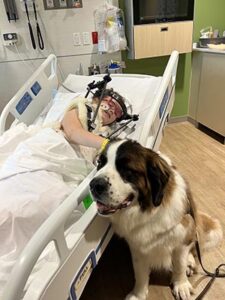
“I remember the St. Bernard. His name is Ryder,” Katy says. “He’s a good dog.” There was also a golden retriever she remembers fondly. “They made me feel really happy because dogs are one of my favorite animals.”
Stabilizing the Spine, Restoring Hope
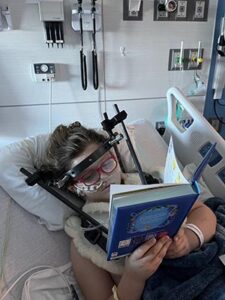 Because of her spinal fracture, Katy required halo traction, a device secured to her skull and attached to a rigid vest to stabilize her neck.
Pediatric neurosurgeon Lori McBride, MD carefully explained every step.
“She’s hung the moon for us,” Renee says. “Katy loved her. We trusted her judgment.”
Dr. McBride and her colleagues worked together to place the halo and guide Katy’s C2 vertebra back into alignment.
When asked what she liked about her neurosurgeon, Katy doesn’t hesitate.
“She’s sweet. She’s funny. She basically knows what she’s doing,” she says. “She’s really kind to children.”
Even after surgery, fear lingered.
“I was pretty nervous,” Katy says. “I was nervous I’d need to be in a wheelchair and be wobbly. They helped me feel less scared, especially in cars, and told me my neck was going to heal.”
Katy wore the halo for more than three months. On August 30, 2024, it was finally removed. Katy returned to school just after Labor Day. She missed the first month of third grade. She finished the year strong.
Forgiveness in the Hardest Places
The driver who hit Jessica and Katy admitted he was impaired.
Renee says one of the hardest but most important lessons for their family was forgiveness.
“It was wrong what he did,” she says. “But we have to forgive. We don’t want to be bitter.”
The family talked openly with Katy about it, even when she cried in frustration and said she wished he hadn’t done what he did.
“Forgiveness can destroy you if you don’t deal with it,” Renee says. “We prayed that God would change his life.”
Carried Through the Darkness
Renee documented the entire journey online so friends and strangers across the country could pray.
“This was one of the darkest times in my life,” she says. “But Psalm 46:1, God is our refuge and strength, a very present help in trouble. He carried us.”
One afternoon, as Renee walked back into the hospital after saying goodbye to her husband, she heard piped-in birdsong echoing through the building.
“It was like God just reminded me that not a sparrow falls without the Father knowing.”
She is now compiling those journal entries into a book for Katy, Jessica and Katy’s Journey of Faith and Healing.
Back to Being a Kid
“I just turned 10,” Katy says with a grin.
Today, she spends her time horseback riding, drawing, crafting, playing piano and singing. She’s in fourth grade and made the A/B honor roll.
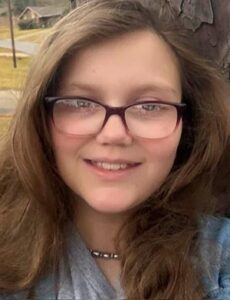 “I’m pretty good now,” she says.
She still occasionally sits out of P.E. She continues follow-ups with Dr. McBride. But she is vibrant. Talkative. Full of life.
“My grandma reminds me how I stay positive through it,” Katy says. “I’m proud of that.”
And when Renee reflects on the hospital that cared for her granddaughter, her voice steadies.
“By the time we really needed help, Our Lady of the Lake was there. God provided that hospital to come through for us. We are forever grateful.”