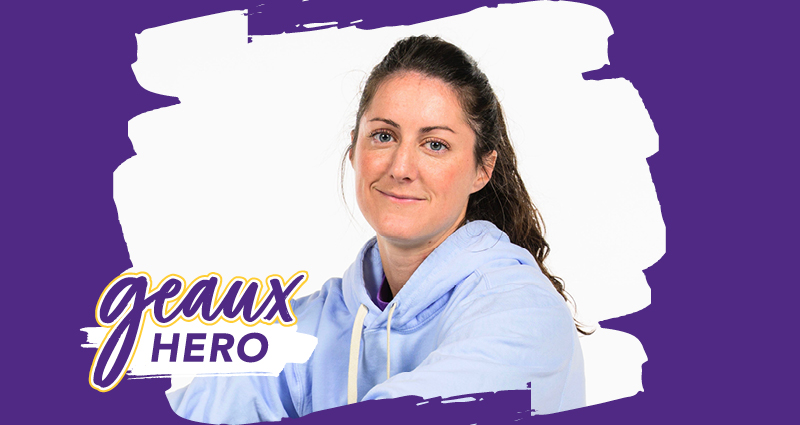
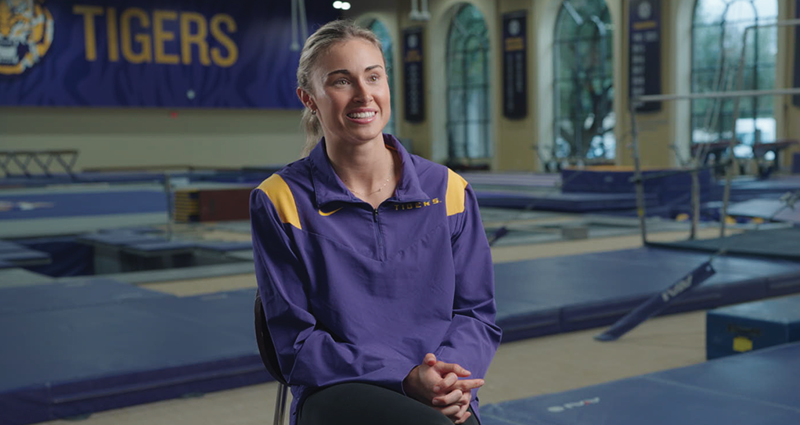
For Kathryn Weilbacher, gymnastics has always been more than a sport. It was the one constant in her life, something she could count on no matter what else was changing.
Having the chance to compete for LSU made that lifelong passion even more meaningful. Growing up, LSU was part of her family story. Her parents, grandparents and aunts all attended the university, and her mother was a cheerleader there.
After three years competing at Bowling Green, Kathryn transferred to LSU, excited for a new chapter.
“I was basically born an LSU fan,” she says. “So being able to actually come here is really cool, like a dream come true.”
But just weeks into the school year in 2024, that dream was suddenly put on hold.
The Accident That Changed Everything
On September 5, Kathryn was driving when another vehicle ran a stop sign and hit her from the driver’s side. The airbags deployed, her left ear rang and the moment felt surreal.
“It felt like a movie,” she recalls. “Like when the explosions go off.”
At first, she believed she was OK. The shock masked the injury, and she assumed she was dealing with little more than a sore back. But on the drive to see LSU athletic trainers, nausea hit. Once inside, bright lights and noise became unbearable.
“That’s when I was like, OK, I probably have a concussion,” Kathryn says.
Testing confirmed it. As an athlete, Kathryn entered the standard concussion return-to-play protocol. But unlike most concussions, hers didn’t improve on a predictable timeline. What followed was far more difficult than she expected.
She dealt with constant headaches, persistent nausea, sensitivity to light and sound, and emotional changes that left her feeling unlike herself. For a gymnast, the symptoms were more than frustrating. They interfered with balance, spatial awareness and safety.
“I’d feel like I was still moving forward,” she says. “It was like, where am I?”
Each attempt to increase training led to setbacks. Some days felt hopeful. Others ended with symptoms that lasted for days.
Retraining the Brain Through Vestibular Therapy
Weeks passed, then months, and her symptoms persisted.
“I just wasn’t getting better the way a normal concussion should,” she says.
With progress stalled, LSU’s athletic training team referred Kathryn to FMOL Health | Our Lady of the Lake. There, she met with a neurologist who ordered imaging to rule out a more serious injury and helped manage her migraines.
From there, Kathryn began vestibular therapy, working closely with vestibular physical therapists Sara MacDowell, DPT, and Sydney Duhe, DPT, at the Our Lady of the Lake Hearing and Balance Center.
When she arrived for therapy, her symptoms affected nearly every part of her life, not just gymnastics.
“She was really struggling both in gymnastics and in her academics,” Sara explains. “The computer screen bothered her. She couldn’t read her notes or study.”
Vestibular therapy focuses on the inner ear and its connection to the brain, a system critical for balance, coordination and visual stability.
“You can imagine in a gymnast who has to flip and turn, she needs to know where she is in space. That system was disrupted in Kathryn,” Sara says. “We take the vestibular system for granted until it’s not working. Those skills are critical for reading, driving and especially gymnastics.”
For an elite athlete, “good enough” wasn’t enough.
“When Kathryn first came in, her symptoms were debilitating,” Sydney says. “We had to break everything down and recalibrate how her balance system was working.”
Therapy began with controlled, repetitive exercises designed to challenge Kathryn’s balance and visual systems. The goal was to retrain her brain to tolerate movement again. Exercises included eye tracking, head movements and visual focus tasks that gradually increased in difficulty. What seemed simple carried real purpose.
Progress was real but uneven. Some days felt encouraging, followed by setbacks that left Kathryn questioning whether she was truly improving.
“The hardest part was that there was no timeline,” Kathryn says. “No one knew when I was going to be better.”
As months passed, her care team uncovered another contributing factor. In addition to the concussion, Kathryn had sustained a whiplash injury in the crash. Tight neck muscles subtly misaligned her head, affecting how her eyes and brain processed movement.
“My head was a little bit crooked,” Kathryn explains. “So my perception through my eyes was messed up.”
A neck specialist worked alongside the vestibular team, coordinating care to address both issues together.
Navigating Setbacks and Uncertainty
At Our Lady of the Lake, Kathryn’s recovery became a collaborative effort. Her medical care included neurology, vestibular therapy and additional treatments, all working toward the same goal.
“There was always something else we could try,” Kathryn says. “And it all worked together to get me to where I am now.”
Vestibular therapy sessions challenged her system in controlled ways, but beyond the clinical care, the personal support mattered just as much. Sara and Sydney prepared her for setbacks and reminded her that recovery from a brain injury is mixed with good days and bad days.
“Recovery is almost never linear,” Sara explains. “We focus on the overall trend improving, not day-to-day perfection.”
Kathryn never felt dismissed or doubted, even during the most frustrating stretches.
“I always felt supported,” she says. “I never felt like people thought I was crazy, even when I thought that myself.”
Returning to the Sport She Loves
Over time, weekly appointments became less frequent. By summer 2025, Kathryn completed formal vestibular therapy and returned fully to training. Routines were rebuilt carefully, one skill at a time.
“It means everything to be able to do this sport again,” she says. “Going through last year is what makes this year even better.”
While she knows migraines or lingering symptoms may still appear from time to time, she feels prepared to manage them.
“I feel 100 percent in my gymnastics,” Kathryn says. “I feel comfortable with where I am and how to handle things when things come up.”
For her care team, seeing Kathryn back in competition is deeply meaningful.
“To get somebody back to what they’re passionate about is everything to us,” Sara says.
Sydney agrees. “Seeing Kathryn get back to a high-level sport like gymnastics is the reason that we do what we do.”