Across FMOL Health | Our Lady of the Lake, clinical research is helping bring the future of medicine to patients today.
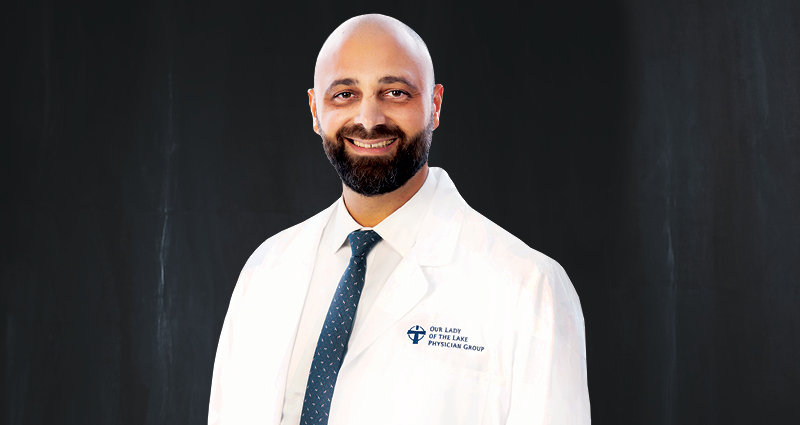
For physicians like Nakhle Saba, MD, director of Lymphoid Malignancy and CAR-T at Our Lady of the Lake Cancer Institute, that work is not separate from patient care. It is central to it. By advancing new therapies through research, his team is expanding what is possible for patients across Baton Rouge and the Gulf South.
“The research would set you apart from any other practice,” says Dr. Saba, who leads clinical trials focused on blood cancers. “If you are a center of excellence, you have to have those latest and cutting-edge treatments.”
From targeted therapies to CAR-T and other emerging treatments, clinical trials are not only improving outcomes for individual patients. They are strengthening the health of the community by ensuring access to the most advanced care, close to home
From Idea to Impact: How Clinical Trials Work
The therapies used in hospitals today are the result of years of structured research and testing. According to Dr. Saba, that process begins with identifying a potential target within a disease and designing a treatment to address it.
“It takes years,” Dr. Saba says. “But what we have now started already years ago, and now it’s making it to clinic.”
New treatments are first studied in a lab, where researchers explore whether a potential therapy has a meaningful and safe effect. Therapy then moves through preclinical testing to better understand how it behaves in a living system. These early steps are designed to answer foundational questions about safety, dosing and potential effectiveness before a treatment ever reaches a patient.
From there, therapies enter human clinical trials, which are carefully structured in phases. Early phase trials are small and focus primarily on safety. As the therapy advances, later phase trials enroll larger and more diverse patient populations to evaluate how well the treatment works compared to existing standards of care. These studies also track longer-term outcomes, such as durability of response, quality of life and overall effectiveness across different patient groups.
Each phase is designed to build a more complete understanding of the therapy, ensuring that by the time it reaches routine clinical use, it has been tested thoroughly, monitored closely, and validated through progressively larger and more rigorous studies.
Even with this rigorous process, the pace of progress is accelerating. Dr. Saba notes that new therapies are moving through trials faster than ever before, with meaningful changes happening regularly.
“We’re seeing changes. This research used to take a long time, and now we’re seeing these newer treatments making it to clinical trials fairly quickly,” Dr. Saba says. “And those trials are moving also fast.”
A Career Shaped by Discovery
Dr. Saba’s path into clinical research began early in his training and has remained central to his work as a physician. From lab-based studies to leading clinical trials, his career has been focused on advancing treatment options for patients with blood cancers.
Today, his work at Our Lady of the Lake is centered on expanding clinical research programs and bringing more trials to patients locally. That effort is deeply collaborative. Dr. Saba works closely with leaders across the health system and the FMOL Health Research Institute to identify, launch and manage trials that can make a meaningful difference for patients.
Clinical research at this level requires coordination across physicians, research coordinators, regulatory teams and national partners. From securing approvals to enrolling patients and tracking outcomes, each step depends on a strong, experienced team working behind the scenes.
“It is time consuming and it’s labor intensive,” Dr. Saba says. “You have to have your research office and a lot of people who are going to take care of a lot of the work behind the curtain.”
Through these partnerships, the team can open a wide range of trials, from early phase studies to large national collaborations. The goal is not only to participate in research, but to build a program that continues to grow and bring new opportunities to patients in the region.
That commitment is about more than reputation. It is about ensuring patients have access to the best possible care without having to leave their community.
Seeing the Impact in Cancer Care
The results of clinical research are already visible in how cancer is treated today. Therapies that were once standard are being replaced by more targeted, less toxic options.
“What we used to do not too long ago when I was a fellow, most of it does not even apply anymore,” Dr. Saba says. “There are diseases that we don’t even use chemotherapy at all.”
In blood cancers like lymphoma and chronic lymphocytic leukemia, treatments are becoming more precise and, in some cases, curative.
“We’re aiming for a cure for a lot of cancers,” he says. “Diseases that were, by definition, incurable, now we start talking, are we curing some of these people?”
That progress is driven by research and reflected in milestones like the first outpatient CAR-T therapy performed in Louisiana at Our Lady of the Lake Cancer Institute. While CAR-T has traditionally required hospitalization, years of research and clinical experience made it possible to safely offer this advanced therapy in an outpatient setting for select patients.
Bringing Advanced Care Closer to Home
For patients in Baton Rouge and the surrounding region, the growth of clinical research means more options and fewer barriers to care. Treatments that once required travel to institutions in Texas or Minnesota are increasingly available close to home.
“There are a lot of trials that we have here that are open at those major centers,” Dr. Saba says. “We can have a good variety of treatment that were not available here to start with.”
Clinical trials also provide options for patients who may not qualify for standard therapies or whose disease has progressed. In some cases, they offer access to promising new treatments when no other options exist.
At the same time, these programs strengthen the entire healthcare system. They bring together physicians, researchers, coordinators and support teams, all working toward a shared goal of improving patient outcomes.