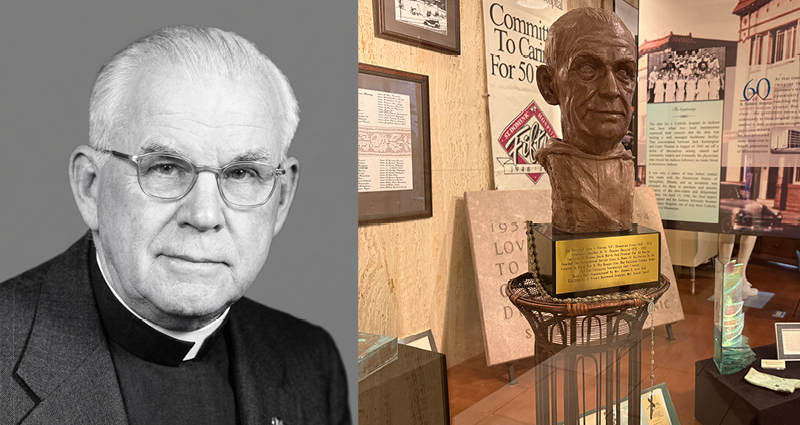
Every morning for 17 years, Father John Leonard Curran walked the halls of St. Dominic Hospital, offering a blessing to every patient he encountered.
His steps were deliberate, slowed by a limp that remained with him for much of his life. Yet he rarely missed a day, quietly bringing comfort and prayer to those in his care.
For patients, he was a comforting presence in a Dominican habit, a gentle reminder of faith during moments of uncertainty. For the Sisters and hospital staff, he was a man of quiet conviction, unwavering discipline and a dry sense of humor.
Few could have imagined the extraordinary journey that brought him to Jackson, Mississippi.
Years before walking the halls of St. Dominic’s, Father Curran had walked a far more treacherous path through the jungles of the Philippines. As a U.S. Army chaplain during World War II, he survived the infamous Bataan Death March, endured years of imprisonment under Japanese forces and witnessed unimaginable suffering while ministering to his fellow soldiers.
The same faith that carried him through captivity would guide his ministry at St. Dominic, where his presence became part of the hospital’s commitment to compassionate, faith-filled care.
Sister Dorothea Sondgeroth, O.P., who worked alongside Father Curran when she started as a dietitian at St. Dominic’s, remembers a man whose extraordinary past was matched by his humility.
“What a phenomenal man he was and what a phenomenal ministry,” Sister Dorothea recalls. “It was a privilege.”
Answering the Call to Serve
Long before the world knew the name Bataan, Father Curran was a young Dominican priest following a calling that would carry him halfway around the world and into one of the darkest chapters of World War II.
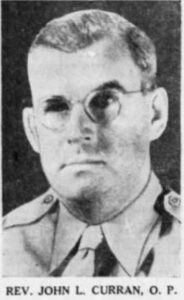 His military journey began in 1937 when he joined the Army Reserve Corps. Over the next several years, he served with the Civilian Conservation Corps and at military installations across the U.S., providing spiritual guidance to soldiers preparing for an uncertain future.
In 1941, when the Army called for volunteer chaplains to serve in the Philippines, Father Curran answered. As he wrote in his memoir, he departed for the Pacific with little idea of what awaited him.
He joined the 88th Field Artillery Regiment of the Philippine Scouts at Fort Stotsenburg. Within months, the tropical landscape of lush forests and towering mountains became a battlefield.
Following the Japanese attack on Pearl Harbor in December 1941, American and Filipino forces retreated toward the Bataan Peninsula. Father Curran accompanied his soldiers through the chaos, ministering amid artillery fire, dwindling supplies and mounting casualties. On Christmas Day 1941, he celebrated Mass in a quiet farmyard as his unit prepared for combat.
Soon, the realities of battle brought Father Curran face to face with unimaginable suffering.
During one of his first encounters with enemy fire, he found a gravely wounded Philippine Scout named Dundine. With shells exploding nearby and little medical assistance available, Father Curran administered the sacraments and remained at the soldier’s side for hours.
He listened as Dundine spoke about his family and his hopes for the future. When the wounded man cried out in pain, Father Curran stayed close, offering prayer and companionship as they waited for help.
It was one of countless moments when Father Curran’s calling placed him beside those facing death, a commitment that would eventually find a new home in the healing ministry of St. Dominic.
Surviving the Bataan Death March
By April 1942, American and Filipino forces defending Bataan were exhausted, malnourished and overwhelmed. Following their surrender on April 9, Japanese forces forced thousands of prisoners to march through the tropical heat with inadequate food, water and medical care.
The ordeal became known as the Bataan Death March, one of World War II’s most notorious atrocities.
Father Curran was among the prisoners.
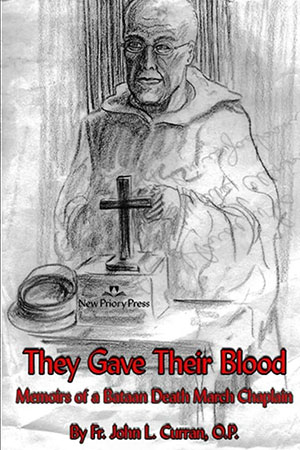
The cover of Father Curran’s memoir, “They Gave Their Blood: Memoirs of a Bataan Death March Chaplain,” features a drawing of him conducting mass in 1944 in a Japanese POW prison.
In his memoir, he recounts staggering through the heat with injured feet, severe nausea and overwhelming exhaustion. At one point, he became convinced he could go no farther. Fellow officers urged him to continue, helping him rejoin the group when transportation became available.
At prison camps, disease, starvation and unsanitary conditions claimed countless lives. Father Curran ministered to the sick, comforted dying prisoners and helped bury the dead. He estimates in his memoir that he buried approximately 2,600 men during his captivity.
One account describes finding a starving soldier lying on a hospital floor. Father Curran secured a cup of pork stew, lifted the man into his arms and helped him eat. The soldier died shortly afterward.
The experience reflected the heartbreaking reality of his daily ministry, where even the smallest acts of kindness carried enormous meaning.
Father Curran was eventually transported to Japan aboard a prisoner ship and forced to work at the Yawata Steel Works. Throughout his imprisonment, he continued celebrating Mass whenever possible, hearing confessions and offering spiritual support.
When Japan surrendered in August 1945, Father Curran finally regained his freedom after more than three years in captivity.
Sister Dorothea remembers that Father Curran rarely spoke at length about his experiences, occasionally referencing them in his homilies. Even without recounting the details, the lessons of those years were evident in how he approached others.
“He was very prayerful, and he was very studious,” she says. “He just inspired many, many people.”
A New Mission at St. Dominic
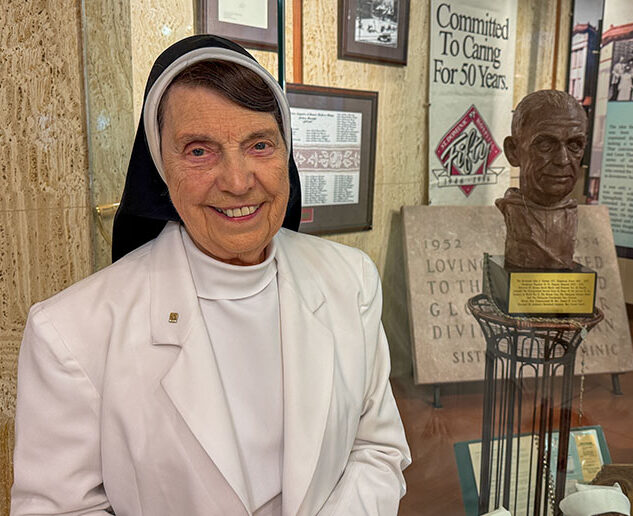
Sister Dorothea Sondgeroth, O.P., next to the bust of Father Curran at the historical display at St. Dominic’s
Father Curran’s return to the U.S. brought another unexpected hardship. In October 1945, while traveling home through Nevada, he was seriously injured in an automobile accident. Already weakened by years of malnutrition and imprisonment, his injuries required an extended hospitalization and left him with a permanent disability.
Despite his physical limitations, Father Curran remained devoted to his calling. In 1947, he returned to Louisiana to minister to the communities of Ponchatoula and Pass Manchac, where he helped build a small church. As his health declined, he was appointed chaplain at St. Dominic’s, where he would serve for 17 years in semi-retirement.
There, Father Curran found a ministry that reflected the values he had carried through the most difficult years of his life. His presence reinforced the hospital’s commitment to treating every patient with dignity, respect and spiritual compassion.
Sister Dorothea remembers his strict schedule, attention to his health and dedication to daily Mass. Despite the lasting effects of his injuries, he faithfully visited patients throughout the hospital.
“He was very punctual, very steady. Just an inspiration, a wonderful man,” Sister Dorothea says.
His personality also revealed a lighter side.
Father Curran enjoyed walking near a ravine beyond the hospital grounds for exercise. Wearing old clothes and a worn hat, he once caught the attention of a patient who mistook him for someone overseeing a nearby dump. The Sisters delighted in teasing him about his new title as “supervisor of the dump.”
Another time, two young patients undergoing tonsillectomies saw Father Curran walking through the pediatric department in his Dominican habit. One excitedly told their mother that a Sister had visited, followed by a “boy nun.”
For all he had endured, Father Curran retained a warmth that endeared him to those around him.
“He was very good at going along with the humor,” Sister Dorothea recalls. “For all he had been through, he still had a sense of humor and a good balance.”
Father Curran developed meaningful relationships with patients, staff and student nurses. He officiated at nursing ceremonies, led monthly gatherings for lay Dominicans and remained a steady spiritual presence throughout the hospital.
Sister Dorothea believes his wartime experiences shaped the compassion he brought to his ministry.
“The experience that he had in the Bataan Death March strengthened him to really be very compassionate to the patients and very respectful of them,” she says.
Father Curran passed away at St. Dominic’s on March 14, 1972. Sister Dorothea remembers student nurses forming an honor guard outside the chapel before his burial at Rosaryville in Louisiana.
Beneath towering pine trees and blooming azaleas, Dominican priests gathered as military honors marked the final farewell to a man who devoted his life to serving God and his country.
Preserving a Remarkable Legacy
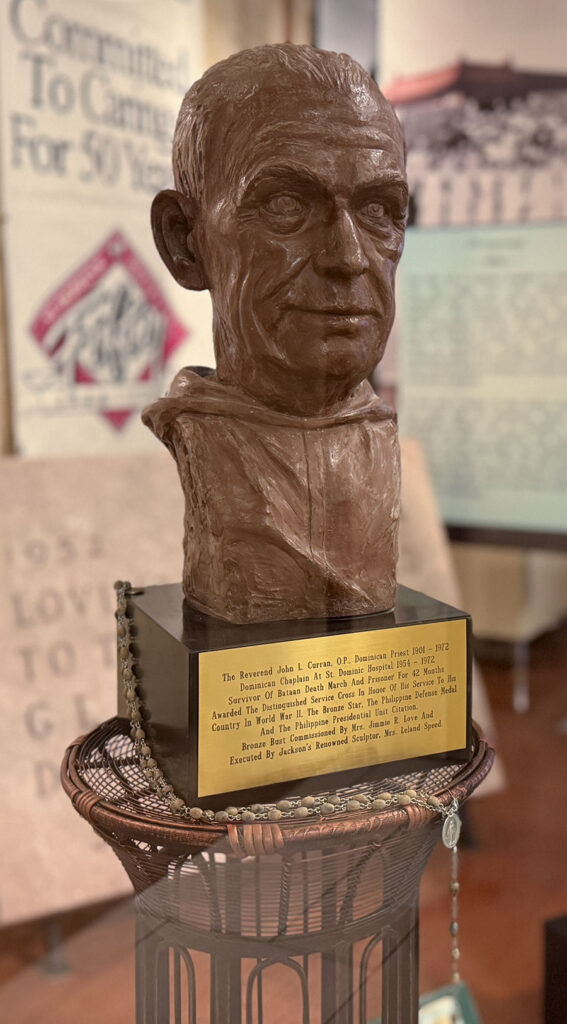
Father Curran’s bust and rosary on display at St. Dominic’s.
Decades after Father Curran’s death, his extraordinary story found new life through the efforts of Bill Fowler, chaplain at FMOL Health | St. Dominic.
Working with Dominican priests and gathering historical materials, Fowler helped bring Father Curran’s wartime writings together for publication as They Gave Their Blood: Memoirs of a Bataan Death March Chaplain.
The memoir preserves his firsthand accounts of combat, captivity and the enduring faith of the men who suffered alongside him. Sister Dorothea contributed materials to the project and remains grateful for Fowler’s determination to preserve the chaplain’s legacy.
“I commend him so much for picking this up,” she says. “When he heard about these memoirs, he really dug into it.”
Today, a particularly meaningful piece of that history remains on display at St. Dominic’s.
Inside the hospital’s museum, a sculpture of Father Curran stands near the rosary he secretly carried beneath his cap during the Bataan Death March. Sister Dorothea preserved the rosary after his death and later donated it to the museum.
The small religious keepsake offers a tangible connection between Father Curran’s wartime experiences and the ministry he later shared with the St. Dominic’s community.
For Sister Dorothea, Father Curran’s story deserves to reach new generations, especially as the nation honors its military veterans.
“His life is a true witness to the gospel in action,” she says. “He left a legacy of greatness for people to follow in his prayerfulness, his faithfulness, his goodness.”
More than 50 years after his passing, Father Curran remains part of St. Dominic’s history, remembered through the patients he comforted, the relationships he built and the remarkable story preserved by those who followed in his footsteps.