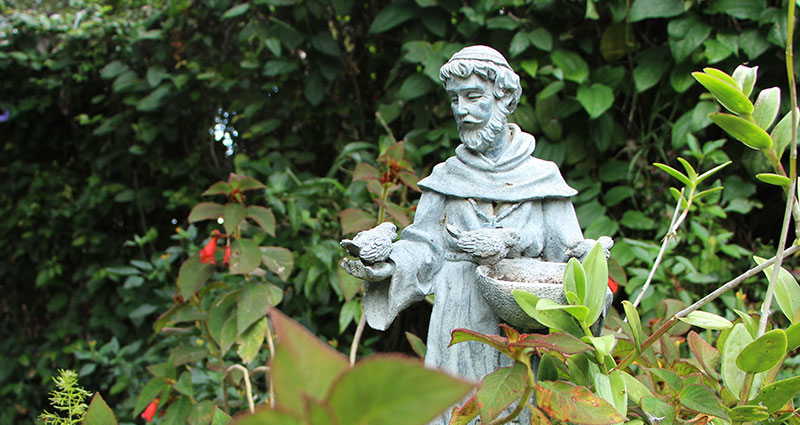
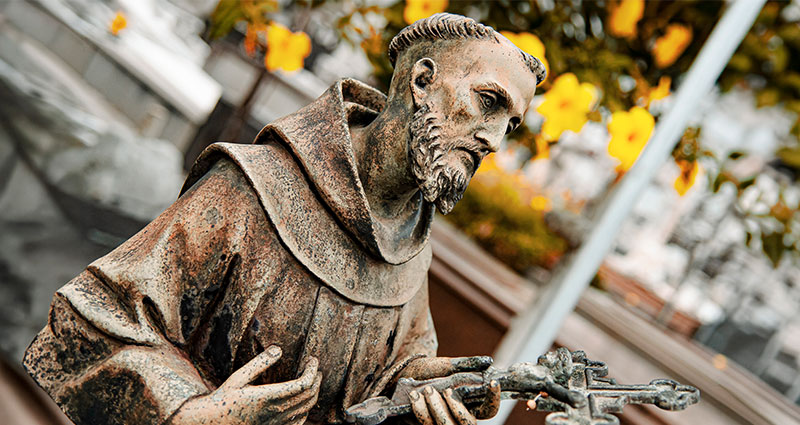
More than 800 years ago, a young man in Italy walked away from comfort and toward purpose.
Francis of Assisi left behind wealth, status and the life his family planned for him. He chose a path of poverty, prayer and radical love. He died in 1226, and his footsteps still lead us today.
As we celebrate Mission Month and the Jubilee Year honoring 800 years since his death, leaders from our Mission team traced six places that shaped St. Francis’ life. Each place marks a turning point in his faith. Each one also speaks to the way we care for patients, families and one another.
1. San Damiano: The Call to Rebuild
Every journey has a first step. For Francis, it happened in a small, crumbling church outside the walls of Assisi.
Around 1205, Francis knelt to pray before a painted crucifix at San Damiano. There, he heard a voice: “Francis, go and repair my house, which, as you see, is falling into ruin.” He took the words literally. He gathered stones, begged for supplies and began rebuilding the chapel with his own hands.
In time, Francis came to understand that the call was bigger than one building. God was asking him to help renew the whole Church, starting with his own heart. San Damiano later became home to St. Clare and her sisters, and it is where Francis is believed to have composed his Canticle of the Creatures near the end of his life.
Rebuilding Hope Today
That same call echoes through our hospitals and clinics. We rebuild hope one patient and one moment at a time. Sometimes that looks like a complex surgery or a hard-won recovery. Sometimes it looks like sitting quietly with a frightened family member. Both are holy work, laid stone by stone.
2. La Maddalena and San Rufino d’Arce: Drawing Near to the Overlooked
Some of the most important places in Francis’ story sit at the edges, where few people wanted to go.
The chapels of La Maddalena and San Rufino d’Arce stood near a leper colony on the outskirts of Assisi. In Francis’ time, people with leprosy were cast out from their communities, feared and forgotten. As a young man of privilege, Francis admitted he could hardly stand to look at them.
Then something changed. Francis drew near. He cared for the people living there, washed their wounds and shared their company. Years later, he wrote in his Testament that what once seemed bitter to him “was turned into sweetness of soul and body.”
Seeing Christ in Every Person
To be Franciscan is to see Christ in every person, especially those others overlook. This is the heart of our special concern for those most in need. It shows up when we serve patients who are uninsured, isolated or struggling, and when we meet every person with dignity, no matter their story. The margins are not the edge of our mission. They are its center.
3. The Porziuncola: Where the Franciscan Movement Was Born
Great movements often begin in small places. The Porziuncola, which means “little portion,” is proof.
This tiny chapel in the woods below Assisi was one of the churches Francis restored. It became home to Francis and his first companions. Here, he heard the Gospel passage that sent the disciples out with no money, no bag and no extra tunic, and he embraced it as his rule of life. Here, St. Clare received her religious habit. And here, on October 3, 1226, Francis died, welcoming what he called “Sister Death.”
Today, the Porziuncola rests inside the Basilica of St. Mary of the Angels. Its humble stone walls remain largely unchanged, a quiet witness to a life lived simply, joyfully and with purpose.
Becoming Something Greater Today
The Porziuncola reminds us that no one carries the mission alone. Francis did not set out to start a movement. He simply lived the Gospel, and others joined him. When we serve together across Louisiana and Mississippi, in every department and every role, we become something greater than ourselves.
4. St. John Lateran: Courage and Conviction
It is one thing to answer a call in private. It takes another kind of courage to bring that call before the world.
In 1209, Francis and a small band of brothers traveled to Rome to seek approval for their Gospel-rooted way of life. They arrived at the Lateran with no power, no status and no influence, only conviction. Tradition holds that Pope Innocent III had dreamed of the Basilica of St. John Lateran beginning to collapse, held up by a small, poor man. When he met Francis, he recognized him. The Pope gave his blessing, and the Franciscan way of life took root.
The Courage to Answer the Call
It took courage for Francis to stand before the Pope. It still takes courage to live a mission like ours. Our teams show it when they advocate for a patient, speak up for safety or choose compassion when the day has been long and hard. Conviction, paired with humility, is how lasting change begins.
5. Greccio: Presence Over Power
Francis had a gift for making faith something people could see, hear and feel. Nowhere was that clearer than in a small hillside town called Greccio.
On Christmas Eve in 1223, Francis wanted to help people experience the humility of Christ’s birth. He arranged a manger with hay, an ox and a donkey in a cave near the town. Villagers came carrying torches and candles, and Mass was celebrated at the manger. It became known as the first living nativity, a tradition that continues in churches and homes around the world.
Francis believed that seeing the poverty of the Christ Child could open any heart. In Greccio, God’s love was not distant or grand. It was close, simple and tender.
Showing Up for One Another
Greccio reminds us that God draws near through presence, not power. In healthcare, presence is one of the greatest gifts we offer. A warm hand, a patient explanation and a moment of undivided attention can mean as much as any treatment. Reverence and love for all of life begin with simply showing up.
6. Mount La Verna: Suffering and Grace
The final stop on this journey leads up a rugged mountain in Tuscany, to a place of deep prayer and profound mystery.
In 1224, Francis withdrew to Mount La Verna for a season of fasting and prayer. Around the Feast of the Exaltation of the Holy Cross, he received the stigmata, the wounds of Christ, in his hands, feet and side. He carried those wounds, along with failing health and near blindness, for the final two years of his life.
Even in suffering, Francis found grace. He did not run from pain. He met it with faith and allowed it to draw him closer to God.
Finding Grace in Hard Places
Our caregivers walk alongside suffering every day. We sit with patients facing difficult diagnoses, families saying goodbye and colleagues carrying heavy burdens. La Verna reminds us that suffering is never the end of the story. Through compassion, prayer and presence, grace can be found even there.
What It Means to Be Franciscan Today
Taken together, these six places tell one story. Francis heard a call and answered it. He drew near to people the world turned away from. He built community, stood firm with courage, chose presence over power and found grace in suffering.
So what does it mean to be Franciscan in a modern world? It means carrying that same spirit into healthcare every day.
- We rebuild hope, one patient and one moment at a time
- We draw near to those who are suffering and those too often overlooked
- We serve together with humility and joy
- We act with courage and conviction
- We offer presence, because healing begins with being there
- We trust in grace, even in the hardest moments
This is where clinical excellence meets genuine compassion. It lives in the core values that guide our ministry: service, reverence and love for all of life, joyfulness of spirit, humility, and justice.