At FMOL Health | Our Lady of the Lake, setting the bar for exceptional care means always looking for ways to raise it.
For the hospital’s surgical teams, that means embracing new technologies, advancing techniques and finding opportunities to improve outcomes for patients across Louisiana.
The latest example of that commitment involves something surprisingly simple: magnets.
Our Lady of the Lake is one of the first medical centers in the United States to offer the GI Windows magnetic anastomosis platform, an innovative technology that uses magnets to connect sections of the digestive tract during surgery.
The technology represents a promising advancement in gastrointestinal surgery, offering the potential for greater precision, fewer complications and shorter procedures. It also reflects the hospital’s continued investment in bringing leading-edge surgical options to patients close to home.
For Mark Hausmann, MD, a general and bariatric surgeon at Our Lady of the Lake, the technology is an exciting addition to the tools available to his surgical team.
“It’s really a pretty simple thing. I wish I had thought of it,” Dr. Hausmann says. “They’ve been developing it for a long time, and we’re excited about implementing it.”
Bringing New Technology to Louisiana
With nearly 30 years of experience in minimally invasive surgery and almost two decades performing robotic procedures, Dr. Hausmann has seen firsthand how surgical technology continues to evolve.
When he first learned about the GI Windows platform at a bariatric surgery meeting, he immediately recognized its potential.
The technology was presented by a physician involved in its development whom Dr. Hausmann had known professionally. After hearing about the platform, he expressed interest in bringing it to Our Lady of the Lake. Once it received approval from the U.S. Food and Drug Administration, the company contacted him about becoming one of its first users.
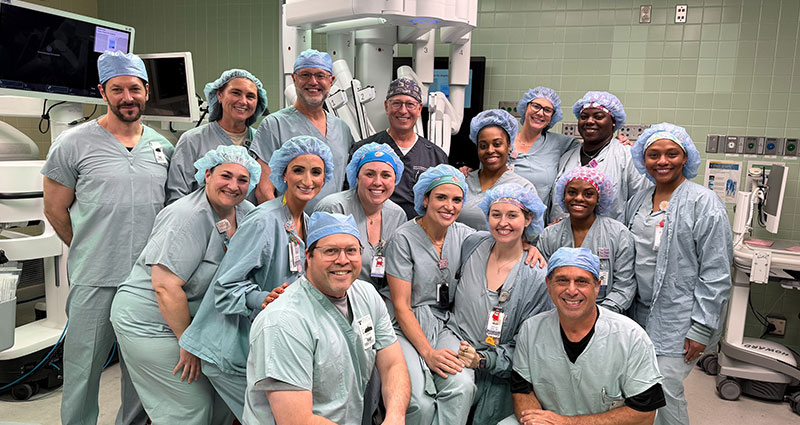
In April 2026, Dr. Hausmann and fellow general and bariatric surgeon Daryl Marx, MD, helped introduce the technology at Our Lady of the Lake, performing the hospital’s first procedure using the magnetic platform.
The opportunity places Our Lady of the Lake among a select group of medical centers gaining firsthand experience with a technology that could help shape the future of gastrointestinal surgery.
“Our team is always looking for ways to safely improve surgical care and the patient experience,” Dr. Hausmann says. “This platform gives us another tool to support complex gastrointestinal procedures and continue raising the standard of care for the communities we serve.”
How Magnetic Technology Works
During many gastrointestinal surgeries, surgeons must reconnect two sections of the digestive tract. This connection, called an anastomosis, has traditionally been created using sutures or surgical staples.
The GI Windows platform introduces another approach using specially designed magnets.
During the procedure, surgeons place a magnet inside each of the two sections of small intestine being connected. The magnets attract one another, holding the tissues together and creating a small initial opening.
Over approximately 10 days to two weeks, the pressure between the magnets allows the tissue to form a larger, more uniform connection as healing occurs. Once that process is complete, the magnets detach and pass naturally through the digestive system.
At Our Lady of the Lake, surgeons are using the platform as part of the hospital’s advanced robotic surgery program.
Traditional techniques remain effective, but the magnetic platform could offer greater consistency by reducing the amount of manipulation required to reconnect the intestine.
“Less adhesions, less scarring and less bleeding,” Dr. Hausmann says.
What It Means for Patients
One of the most immediate benefits of the magnetic platform is greater efficiency during surgery.
Creating a connection using traditional suturing techniques can take anywhere from 15 to 30 minutes, depending on the procedure. With the magnetic platform, surgeons can complete that step in approximately five to 10 minutes.
That time savings can also reduce how long patients spend under anesthesia.
Beyond efficiency, surgeons anticipate several potential long-term benefits, including less bleeding, reduced scar tissue and fewer adhesions, which occur when internal tissues stick together during healing.
Another potential advantage is reducing the risk of narrowing at the surgical connection, a complication known as a stricture or stenosis. A more uniform opening could help prevent this issue and reduce the need for additional procedures.
Dr. Hausmann emphasizes that traditional techniques already produce strong results, and more experience and clinical data will be needed to determine the full benefits of magnetic anastomosis.
Currently, the platform is FDA-approved for connecting two sections of the small intestine. At Our Lady of the Lake, surgeons are using it during gastric bypass procedures.
As the technology develops, its potential applications could expand to include connections between the stomach and intestine or different sections of the colon, pending additional regulatory approvals.
“As the indications increase, the applications are obviously going to explode,” Dr. Hausmann says.
These future possibilities could make the platform useful across a broader range of gastrointestinal procedures.
Continuing to Raise the Standard of Care
Introducing the GI Windows platform is part of a larger commitment to surgical innovation at Our Lady of the Lake.
Through its Robotic Surgery Institute, the hospital continues to expand access to minimally invasive procedures and advanced technologies that support more precise, efficient surgical care.
That approach has helped position Our Lady of the Lake as a regional destination for complex surgical care, giving patients throughout Baton Rouge, Louisiana and the Gulf South access to specialized expertise and emerging treatments.
For Dr. Hausmann, embracing innovation is an ongoing effort to identify tools and techniques that can make a meaningful difference for patients.
“We always use technology to benefit patients,” Dr. Hausmann says. “We’re recognizing and acknowledging new technology and where it can provide better patient care. Our Lady of the Lake has helped us embrace that.”