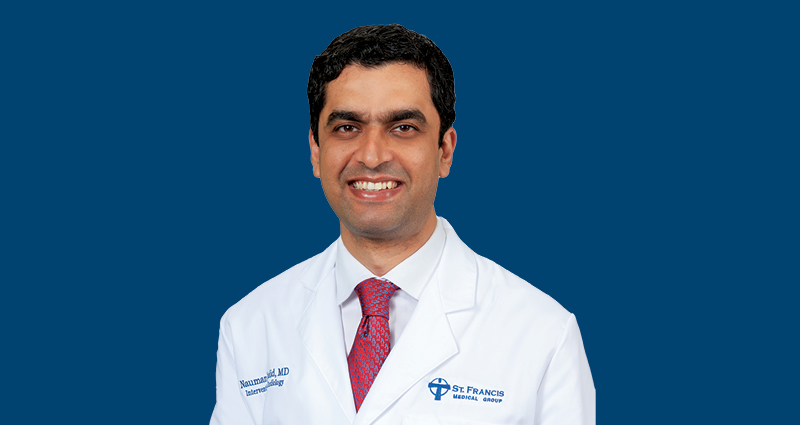
For Nauman Khalid, MD, clinical research is not separate from patient care. It is a natural extension of it.
As an interventional cardiologist at FMOL Health | St. Francis, he sees firsthand how new therapies move from theory to practice, and how that process shapes the future of medicine. His path into research began during his training in academic medical centers, where clinical trials were part of daily work. Bringing that same mindset to a community hospital has become a personal mission.
“Research is important because as new therapies become available, the only way to see their efficacy and clinical use, you have to test them in randomized trials, which are the strongest studies we have,” Dr. Khalid says. “When you compare a therapy in a randomized trial, you get strong data, and based on that, you can see its utility.”
That belief drives his work today. For Dr. Khalid, participating in clinical trials is about advancing science while also expanding what is possible for the patients he treats every day.
Bringing Innovation to a Community Hospital
Clinical research is often associated with large academic institutions, but its impact is just as meaningful in a community setting. At St. Francis, research represents an opportunity to close gaps in access and bring leading-edge care closer to home.
“I feel like in rural America, we are a little behind,” Dr. Khalid says. “One advantage of being part of a randomized trial is that if there is a device being tested, you get access to it early, even before it is commercially available.”
That early access matters for both physicians and patients. It allows clinicians to gain experience with emerging therapies and gives patients the opportunity to benefit from advancements sooner than they otherwise might. It also creates a pathway for community hospitals to play a role in shaping the future of care, rather than waiting for it to arrive.
At St. Francis, the need is clear. The region carries a high burden of cardiovascular disease, and patients often face barriers tied to access, education and resources. Clinical research offers a way to address those challenges while contributing to broader medical progress.
“There are a lot of patients who need help. You just need a proper system available,” Dr. Khalid says.
Building that system has been part of the work. Establishing processes, navigating approvals and creating a culture that supports research takes time. But it also lays the foundation for long-term growth, not only for physicians, but for residents and care teams who want to be part of something larger.
A Milestone Moment: The IMPROVE Trial
That foundation was put to the test with St. Francis’ participation in the IMPROVE trial, a large, randomized study examining how intravascular ultrasound can guide stenting procedures and improve patient outcomes.
Despite early hurdles, including delays in approvals, the St. Francis team moved quickly once the trial was underway. Within about a year, they enrolled 37 patients, placing the hospital among top-performing sites nationally in its first clinical trial.
“We enrolled 37 patients, which is a testament to our hard work,” Dr. Khalid says. “That means we can do it.”
The study itself focused on tools already used in everyday practice, but aimed to answer a critical question about how those tools can be used more effectively. For patients, participation meant contributing to research that could refine and improve care for others in the future.
“If I explain it in that way, they understand and they are happy to participate,” Dr. Khalid says. “My message to patients is they are doing a great service. That is how we promote science.”
The success of the IMPROVE trial did more than demonstrate strong enrollment and data quality. It showed that a community hospital can meet the highest standards of research and contribute meaningfully to national studies.
Building the Future of Research at St. Francis
With one successful trial completed, the focus now shifts to what comes next. For Dr. Khalid, the goal is not just to participate in research, but to build a sustainable program that continues to grow.
“There were some hurdles, but that is part of building the system,” he says. “If we want our institute to advance to the next level, we have to do this.”
For patients, the impact is direct. Clinical trials offer access to advanced therapies that might not otherwise be available locally. For providers, they create opportunities to stay at the forefront of innovation. For the community, they ensure that progress in medicine is not limited by geography.
“Doing research and participating in randomized trials, that is the best thing we can do,” Dr. Khalid says.
At St. Francis, that work is just beginning. The early success of the IMPROVE trial signals what is possible when the right systems, people and purpose come together.