A smile can communicate joy, warmth, reassurance and connection without saying a word.
When an injury or disorder affects the facial nerve, patients can lose movements they once performed without thinking, along with functions that shape how they interact with the people around them.
At the FMOL Health | Our Lady of the Lake Center for Facial Nerve Disorders, specialists are helping patients regain that movement through advanced surgery, specialized physical therapy and innovative treatments developed through years of research and collaboration.
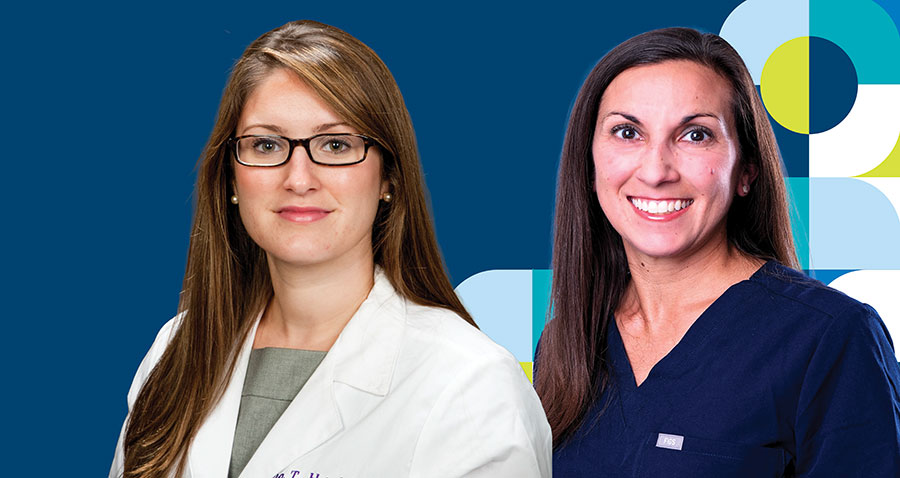
The center brings together facial plastic and reconstructive surgeon Laura Hetzler, MD, FACS, and Sara MacDowell, PT, DPT, AVPT, a physical therapist with more than 16 years of specialized clinical experience treating vestibular and facial nerve disorders.
Together, they determine what each patient has lost, what can be restored and how to help that person return to the activities and interactions that matter most.
Building a Clinic Around an Unmet Need
The roots of the program began more than a decade ago at Our Lady of the Lake Hearing and Balance Center, where MacDowell initially specialized in vestibular rehabilitation.
Because the vestibular and facial nerves travel alongside each other, she also encountered patients with facial weakness or paralysis related to Bell’s palsy, Ramsay Hunt syndrome, acoustic neuromas, trauma and other nerve injuries. At the time, specialized facial nerve rehabilitation was difficult to find.
“There was nobody trained in facial nerve rehab in the entire South,” MacDowell says. “We had patients with facial nerve deficits, but we had nowhere to send these patients for care.”
MacDowell pursued advanced education in facial nerve rehabilitation while Dr. Hetzler developed her expertise in facial reanimation and reconstructive surgery. By 2017, they had formally brought their specialties together in a multidisciplinary facial nerve clinic.
“I think when we’re looking at the same patient with my surgical and anatomic knowledge and her therapy knowledge, we get better outcomes,” Dr. Hetzler says. “We see things that other people don’t see.”
Today, that collaboration allows them to evaluate facial movement from different perspectives and develop an individualized treatment plan together.
Advancing Facial Nerve Surgery and Technology
Facial nerve care has changed dramatically in recent years, and the team at Our Lady of the Lake has helped contribute to that progress.
Depending on a patient’s condition, surgical options can include nerve grafts, muscle transfers and advanced facial reanimation procedures.
One option is selective neurectomy for certain patients with synkinesis, a condition that causes unintended facial movements as a damaged nerve heals. A patient may smile, for example, while the eye involuntarily closes or other muscles contract. During surgery, Dr. Hetzler and MacDowell work together to identify the nerve branches contributing to those unwanted movements while protecting the branches responsible for the movements the patient wants to keep.
Their innovation also extends beyond surgery. The team developed and published an anatomic concept involving targeted Botox injections around the nose to address muscles that can pull the upper lip downward and limit a patient’s smile. The approach became known among facial nerve therapists as the MacDowell Method.
Dr. Hetzler and MacDowell also participate in international facial nerve meetings, publish research and exchange ideas with specialists around the world.
“We’re doing new procedures that were really only pioneered in the last five years,” Dr. Hetzler says. “I don’t think there are many things in medicine where you can say you are part of the leading edge, and that’s really exciting.”
Retraining the Face Through Specialized Therapy
Surgery represents only part of facial nerve recovery. Specialized physical therapy can help patients retrain movement, reduce unwanted muscle activity and gain greater control over facial expression.
Patients often work with MacDowell for several months, practicing exercises and neuromuscular retraining between appointments. Treatment can progress from therapy to Botox injections and, when appropriate, surgery.
“The fact that we can do everything from the conservative therapy to mid-level Botox to these really advanced surgeries, and the fact that Dr. Hetzler and I work truly together, sets us apart,” MacDowell says.
That partnership continues after surgery. Procedures can reconnect nerves or reposition muscles, while therapy helps patients learn how to use them effectively.
“I can be a technician and I can hook your nerves back together,” Dr. Hetzler says. “But what Sara brings with retraining the face, retraining the muscles, and retraining the brain helps get patients as close to normal as possible.”
Helping Patients Feel Like Themselves Again
Facial nerve disorders affect much more than appearance. Facial movement plays an important role in eating, drinking, speaking, blinking and protecting the eye. It also shapes the nonverbal cues people use every day.
“About 80% of how we communicate with the world is through nonverbal expression,” MacDowell says. “It’s incredibly important for things like showing that we’re listening, expressing humor, or conveying care and concern.”
Dr. Hetzler sees patients who stop going to restaurants, stores or social events because they are worried about drooling, asymmetry or how others may react.
“Their smile is the thumbprint of their personality,” Dr. Hetzler says. “The goal is getting patients back to their new normal.”
That understanding shapes how the center defines success. The team considers measurements of facial symmetry and movement along with what improvement means in a patient’s everyday life. That could mean participating in a Zoom meeting, ordering coffee, returning to church or smiling for a photograph at a daughter’s wedding.
“We try to set really tangible goals,” MacDowell says. “We are much better than where we were, and I think we can make almost anybody better, but we try not to promise perfection.”
MacDowell remembers one patient telling her, “I’ve always felt like I’ve had two faces, one that’s happy and one that’s sad. And I finally feel like I can be all happy again.”
World-Class Facial Nerve Care in Baton Rouge
The expertise available through the Center for Facial Nerve Disorders draws patients from across the Southeast, other parts of the country and even internationally.
Dr. Hetzler and MacDowell have presented their research internationally, and specialists at other major academic centers have looked to their multidisciplinary clinic as an example of how surgeons and therapists can work more closely together.
For the team, providing that level of specialized care in Baton Rouge is especially meaningful.
“We are one of the best centers in the world. We just happen to be here because we are born and bred Louisiana,” MacDowell says. “I’m really proud that a place like Baton Rouge can support this kind of a clinic.”