Some places in healthcare never slow down. The emergency department at FMOL Health | Our Lady of the Lake Regional Medical Center is one of them.
On any given day, the Our Lady of the Lake Regional Medical Center emergency room cares for about 250 patients and welcomes 90 ambulances. As the region’s only Level I trauma center and a comprehensive stroke center, it draws the sickest, most time-sensitive patients from across Greater Baton Rouge and beyond.
In this episode of E.J. IRL, FMOL Health President & CEO E.J. Kuiper spent a day inside that fast-paced world. From a helicopter ride to the triage room, he set out to see what it really takes to care for a community when every second counts.

Organized Chaos
Walk into the emergency department on a busy afternoon, and you might miss just how much is happening. That’s by design.
Mark Laperouse, MD, medical director of emergency services, calls it “organized chaos.” The team can be mid-task when a stroke alert or trauma activation crackles overhead, and everyone pivots in an instant.
On the day E.J. visited, Dr. Laperouse counted 12 ambulances on the parking deck at one time. That’s a lot of ambulances, and a lot of sick people, all at once.
“Our team handles it with grace,” he says. “We do that every single day.”
For the people who work here, the pace isn’t a burden. It’s the draw.
“Everybody who works in the emergency department, if you work there for a long period of time, it’s because we absolutely love it to our core,” Dr. Laperouse says.
Roger Marquez, RN, an ER nurse who first came to the Lake as a tech back in 2005, agrees.
“We are the busiest ER in the state, and there’s no way around it,” he says. “The team helps each other, carry each other to the end of the day, where we can just go ahead and do it all over again.”
A Partnership That Takes Flight
Emergency care doesn’t start at the hospital doors. It often begins miles away.
Our Lady of the Lake relies on partners like Acadian Ambulance to bring patients in and move them between facilities. Acadian’s helicopter service is part of that lifeline, with a patient arriving by air at least once a day, weather permitting.
“Being the regional medical center, Level I trauma center, comprehensive stroke center, we receive patients from all over,” Dr. Laperouse says. “We see their flight crews every single day.”
The relationship runs both ways. When the team moves quickly to get patients off Acadian’s stretchers, those crews can get back into the community faster.
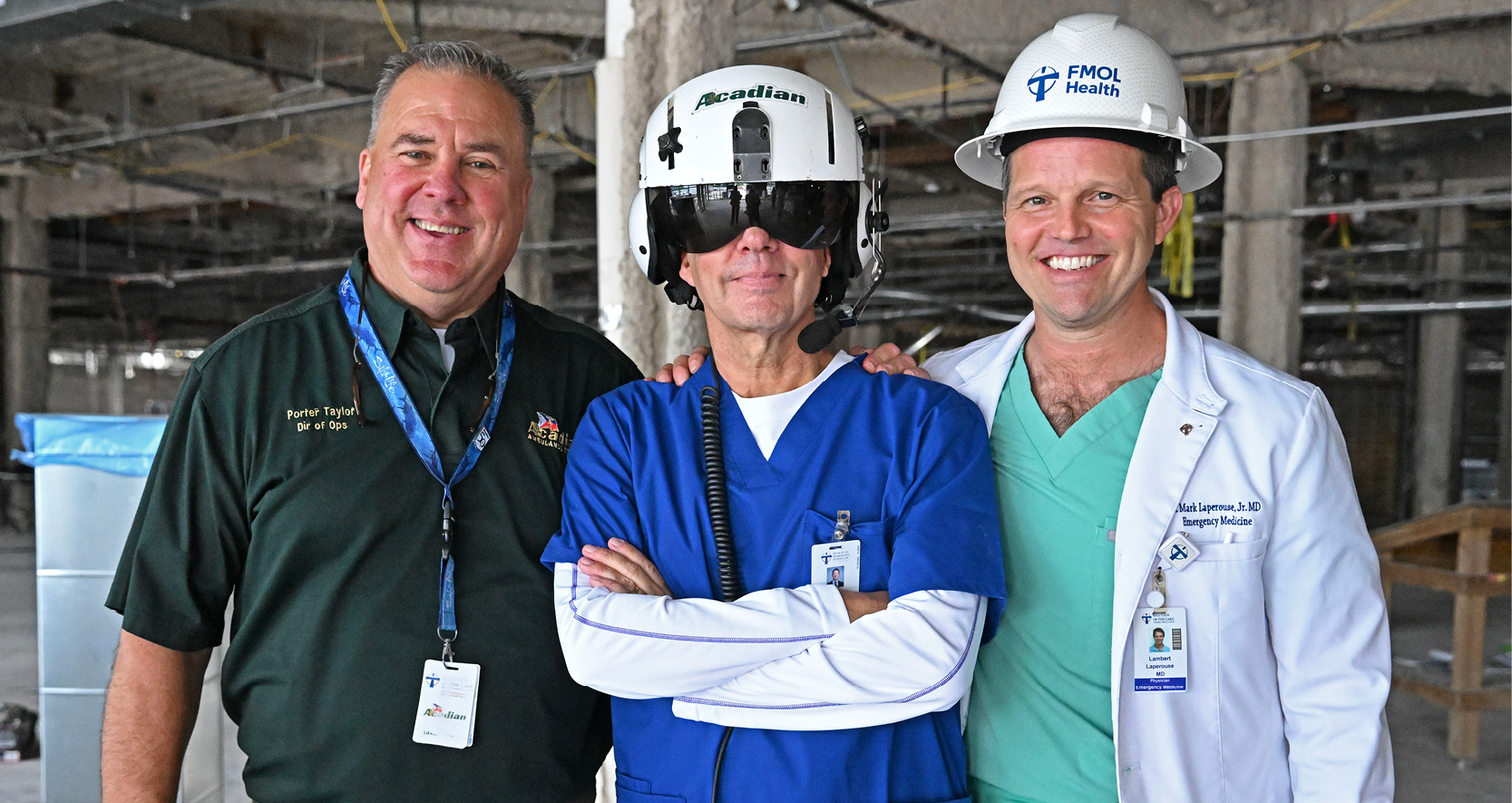
E.J. saw it firsthand, flight suit and helmet on, taking in the view of Baton Rouge from the air.
“When we got up there, looking down at the Lake campus, and then seeing our Children’s Hospital just down the street, it reminds you of all the great work happening here every day,” E.J. says.
A Team Who Shows Up
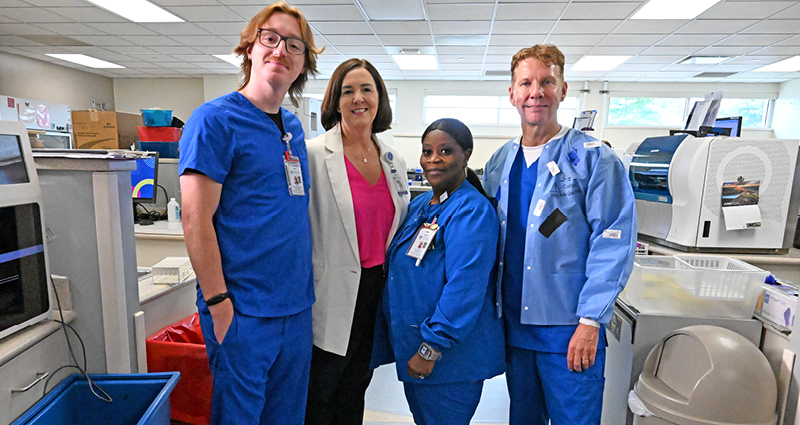
Before the work begins, the ER team gathers. One of E.J.’s first stops was the morning huddle, where he met Bridget Jones, MSN, RN, senior director of nursing in the emergency department, and the nurses who keep the ER running.
Huddles set the tone for the day. They’re where the team talks through what’s ahead and where they pause to recognize one another. During E.J.’s visit, he read aloud a patient’s family letter praising a team member for the care and joy she brought to a stressful day.
For Bridget, moments like that are the point.
“We get patient stories all the time, and when we get descriptive stories about specific team members, we love to share them,” she says. “You almost see other team members replicate those behaviors.”
Then it was time for E.J. to roll up his sleeves.
The Art of Triage
Before any treatment begins, every patient passes through triage. E.J. shadowed Roger, who calls triage the most important step in the ER process.
“The most dangerous person in the ER is the untreated, the one we don’t know anything about,” Roger says.
In 10 minutes or less, nurses have to narrow down what might be wrong, order tests and point each patient in the right direction. It’s a learned skill few outside the department fully appreciate.
E.J. tried his hand at triage and quickly learned the lesson everyone learns.
“It was a little hectic for me, and I made a couple of mistakes,” he says. “What’s impressive is they have, in a short period of time, to narrow down what the diagnosis might be.”
Then the scenario turned. Our “patient,” team member Jerome Kelly, was pretending to have a heart attack and suddenly collapsed, sending E.J. into hands-on action.
Bridget watched the triage lesson with pride.
“Triage is a skill, and it’s a learned skill,” she says. She wasn’t worried about a few stumbles during a simulation. She’s proud her team gets to show what they do every day.
Teamwork When It Matters Most
The phrase “organized chaos” sounds like a contradiction, until you watch the team work. People who have worked side by side for years don’t always need words.
“They don’t even have to verbally communicate,” E.J. says. “They know what to expect from one another, and they only have one goal: to create an environment where patients are taken care of.”
That coordination showed itself in a sobering way during E.J.’s visit, when the team called a real trauma code mid-filming. Caregivers flooded the trauma room from across the hospital, ready and waiting.
“It’s all fun and games, and we have fun with the team,” E.J. says. “But then you hear that overhead announcement, and you know somebody is in critical need of care. For the caregivers to snap into place is something I’ll remember for quite some time.”
Building for the Future
The contrast was hard to miss. One moment, E.J. was inside one of the busiest emergency departments in the state. The next, he was walking through a huge section of the space stripped down to the studs — a raw, cavernous area already beginning to point toward something new.
That space is part of the Lake’s ongoing $55 million renovation of its emergency department. The project will unfold in three phases while keeping the ED fully operational 24/7. It will add 20 expanded treatment spaces, improve patient flow and bring in state-of-the-art technology.
That kind of work happens in the middle of a department that never closes. Wesley Switzer, construction superintendent with Milton J. Womack, Inc., and his crew are on-site building the future of the ED around the team’s daily rhythm, one phase at a time.
The fix isn’t more square feet. It’s more rooms.
“When we add a significant number of rooms, we are going to dramatically reduce the wait times,” Dr. Laperouse says. “Then the quality of care we’ve been providing inside the rooms is going to be more evident for every single patient.”
The new design also changes the experience of being a patient. As a faith-based ministry, the Lake welcomes everyone, and the redesigned space honors that mission.
“The new design is way less exposed and creates more privacy,” Dr. Laperouse says. “It’s going to be a lot more intimate, so you can focus on getting healthy.”
For E.J., the investment reflects a deeper commitment.
“More and more patients are choosing to come to the Lake for care, including to our ED,” he says. “We’re a growing Level I trauma center. We have to invest in the infrastructure.”
Caring for the Caregivers
One piece of the renovation isn’t about patients at all. It’s about the people who care for them: an upgraded break room where staff can step away and recharge.
Bridget knows how few minutes her team gets.
“They don’t get very many minutes to get away,” she says. “An opportunity to grab a coffee, or to sit in a relaxing chair and just have a quiet space, would be a time for them to recharge. Sometimes it just takes a few minutes.”
E.J. sees it as part of a larger philosophy.
“I always talk about investing in our people, and we always will,” he says. “But I also have to make sure we give our caregivers the tools to be successful.”
The Mission Behind the Work
For all the talk of volume and square footage, the people at Our Lady of the Lake keep coming back to something harder to measure.
Bridget started here a decade ago and has come full circle.
“The deeper part is the mission and the service, and the fact that we show up for this community every day,” she says. “I wouldn’t want to work anywhere else.”
Dr. Laperouse feels it in his bones.
“I get goosebumps when I say I work at the Lake,” he says. “That means I work at the place the sickest patients in Louisiana come to in their time of need.”
When he sits in the crowd at a kid’s baseball game or an LSU football game, he knows the community is safe.
“If we’re going to call ourselves a Level I trauma center and a comprehensive stroke center, we have to back it up.”
That’s the work happening behind the organized chaos. Every day, around the clock, with grace. And as the renovation takes shape, the team will keep showing up, carrying each other to the end of the day, then doing it all over again.