A saliva sample collected on the sideline of a football game could someday help answer an important question: Is it safe for an athlete to keep playing?
That possibility is at the center of new concussion research bringing together experts from FMOL Health | Our Lady of the Lake, LSU and Pennington Biomedical Research Center. Researchers are studying proteins found in the saliva of college football players in search of biomarkers that could provide another tool for identifying brain injuries.
The project is one of seven research initiatives receiving more than $1.6 million through the Collaboration in Action Program, or CAP. The competitive grant program between Our Lady of the Lake and LSU supports new approaches to some of Louisiana’s most important health challenges.
For this project, that work starts on the football field, with the potential to reach far beyond it.
Bringing New Ideas to Life Through CAP
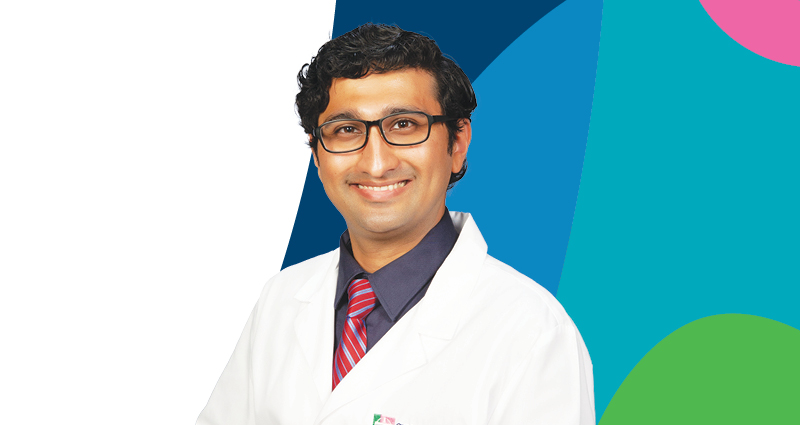
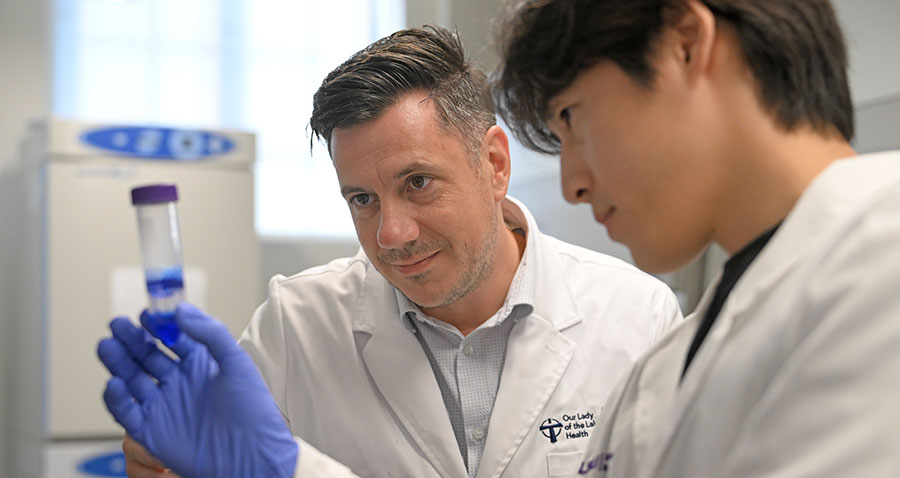
The concussion study is led by Guillaume Spielmann, PhD, associate professor in the LSU School of Kinesiology and lead trauma researcher at Our Lady of the Lake. An exercise immunologist, Dr. Spielmann studies how physical and psychological stress affect the immune system. Years of research with LSU Athletics eventually led his team to examine what happens to the brain after the repeated impacts that are part of football.
In an earlier study of more than 40 football players, researchers found that some blood proteins associated with traumatic brain injury increased even when athletes were not concussed and showed no changes in brain structure or function. The findings prompted Dr. Spielmann and his team to search for more precise biomarkers using saliva, which can be collected easily and frequently.
“Concussions and repetitive head impacts remain a significant concern for athletes, yet we still lack practical tools to detect and monitor brain injury early and accurately in real-world settings,” Dr. Spielmann says.
Searching Saliva for Signs of Brain Injury
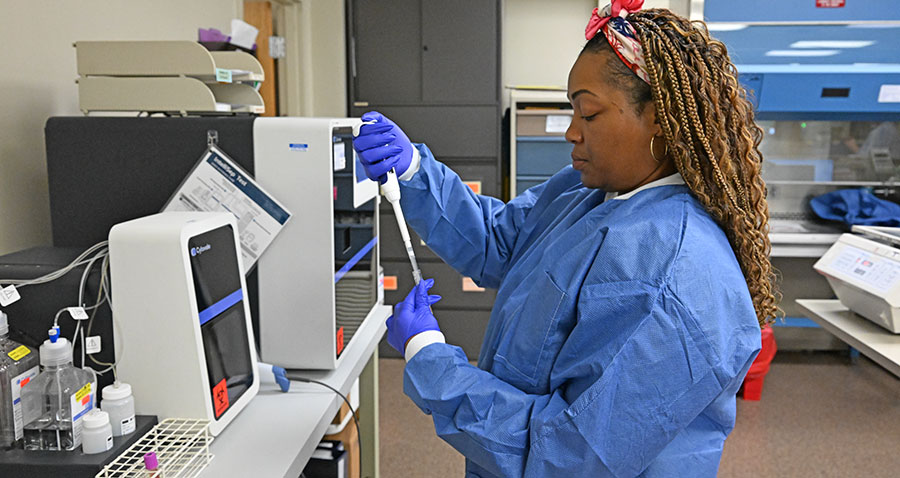
Throughout the 2026 football season, researchers plan to collect saliva from approximately 40 to 60 LSU football players at regular intervals and analyze how proteins in those samples change over time.
If an athlete sustains a concussion, the team will collect additional saliva and blood. Researchers can then compare the results with samples from players who have not been diagnosed with a concussion and with established assessments of balance, eye movement, memory and cognition.
“We’re trying to identify those proteins that may be related to some specific changes,” Dr. Spielmann says.
The team expects to collect samples through the football season, with an initial analysis targeted for June 2027. If researchers identify promising biomarkers, the findings could provide the foundation for future studies and eventually a rapid, noninvasive test.
“My ultimate goal would be, if we find proteins of interest, can we develop a rapid diagnostic test where you’re on the side of the field and, for lack of a better word, spit in a tube?” Dr. Spielmann says.
Such a test would add another objective piece of information to the clinical evaluations already used to diagnose concussions. Dr. Spielmann emphasizes that the research remains early, and any biomarkers identified would need further study and validation.
Potential Beyond the Football Field
While college football provides the setting for the initial study, the potential applications extend to many other people at risk for brain injury.
Military personnel may experience impacts or blast overpressure. First responders can work in unpredictable environments where injuries happen far from traditional medical resources. Researchers could eventually explore whether the approach has value for children and other patients following traumatic injuries.
Saliva could be particularly useful in those situations because it can be collected without needles or specialized blood processing equipment.
“If you are in a field or if you are far away from a place where you can take blood, using saliva is a very easy method to really detect something without having to be invasive,” Dr. Spielmann says.
If the football study produces promising results, Dr. Spielmann hopes to expand the research to other populations, including warfighters and first responders, to determine how well the findings translate to different types of injuries and environments.
Collaboration Creates New Possibilities
The project brings together experts from LSU, Pennington Biomedical and Our Lady of the Lake with backgrounds in kinesiology, medicine, sports performance, athletic training and clinical research.
It also connects with LSU’s Institute for the Health and Performance of Champions, or IHPC, which focuses on the health, well-being and performance of competitive, tactical and operational athletes.
For Dr. Spielmann, bringing those different perspectives together is essential to advancing research and translating discoveries into practical applications.
“I think siloed science, where you have one scientist that does all the work, has died,” Dr. Spielmann says. “We have the chance of having a really good collaboration with all those entities at LSU and beyond.”
That approach is also central to CAP. This year’s seven funded projects address cancer, trauma, heart and lung disease, sports medicine and performance, and medical data science. Together, they connect researchers and clinicians around questions that could ultimately lead to better ways to prevent, identify and treat health conditions.
Moving Brain Health Research Forward
The concussion study is still in its early stages. Researchers first need to determine whether saliva contains biomarkers that can reliably provide useful information about brain injury. What they learn could guide future studies in athletes, military personnel, first responders and other populations.
“Hopefully we’ll be able to really pinpoint what’s useful and how we can prevent further damage,” Dr. Spielmann says.
Through CAP and the Championship Health Partnership, Our Lady of the Lake and LSU are creating opportunities to move promising ideas forward by connecting scientific research with clinical expertise and real-world needs.
For Dr. Spielmann and his team, that work begins with football players and a simple saliva sample. What they discover could help shape new approaches to protecting brain health for athletes and many others in the years ahead.